The AI-Era Data Engineer
Data & Analytics Engineering Certificate Program
Every AI system runs on data. This course trains the engineer who builds it.
Dashboards, models and AI assistants are only as good as the pipelines underneath them. Someone has to move the data, test it, keep it fresh and make it ready for AI. In five months, that engineer is you.
Next Cohort
March 2027
Seats
50
Fee
$748
You set the goal. AI does the work. You make the call.
4
Production-style pipelines
Batch → streaming
→ GenAI-ready
SQL + Python
Prerequisites
No laptop-only demos
Four production-style pipelines you build and ship.
Every pipeline runs on a schedule in the cloud, with tests, monitoring and cost tracking — the way data teams actually ship.
Foundations
A daily pipeline from an API into the warehouse, monitored and resilient
Modern data stack
A dbt project with tested, documented models
Streaming
A real-time fraud pipeline on Kafka, Spark and Delta Lake
GenAI data layer
A RAG-ready document pipeline that AI products depend on
Market signal
Every AI system needs a data engineer behind it
The AI boom created massive demand for data infrastructure — and data engineers who can build AI-ready pipelines are the scarcest of all.
Naukri #4 most in-demand
Naukri JobSpeak (April 2026) ranked Data Platform Engineer the #4 most in-demand AI/ML role in India, with supply estimated at only around 140,000.
GenAI-infra specialists earn more
Data engineers who can build vector, embedding and RAG-ready pipelines command a 40–50% premium over standard data engineering roles.
Durable against AI
Data infrastructure is the layer AI depends on. As AI adoption grows, demand for the engineers who build the plumbing grows with it.
Sources: Naukri JobSpeak April 2026 · AIM Research 2025 · India salary benchmarks
More than a course
Most courses end when the last video ends. Ours keeps supporting your job search after the lessons end.
Alongside the course, you get the AI tools we built to carry you from your first lesson through your job search. They sit on one platform and they know your projects, so every resume and every mock interview is built from work you actually did.
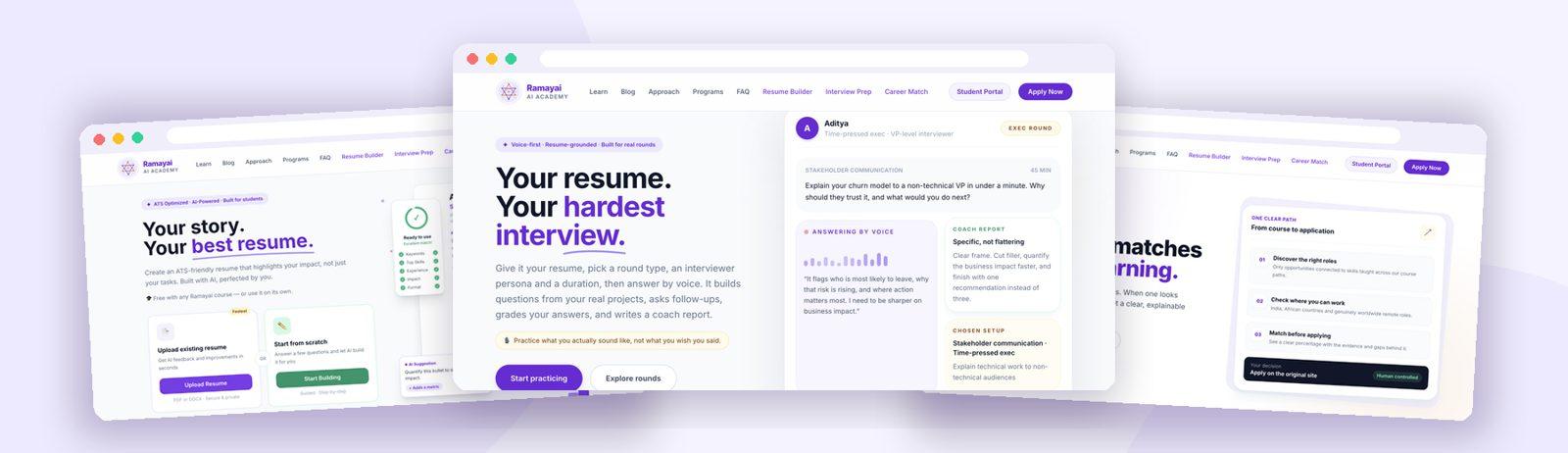
Resume Builder
Turns your four pipelines into a resume tailored to each job description — and it is designed to use only experience you actually have.
🎙️Interview Prep
Runs voice mock interviews built from your own projects. It keeps drilling when an answer stays vague, then hands you a coach report on what broke down.
🎯Career Match
Shows live data engineering jobs, matches them against your resume, and explains the gaps before you apply. You always apply yourself, on the employer’s own page.
The 5-month journey
Each month: a bigger pipeline, and a system you ship.
Production-style pipelines, not laptop demos. Each month you build a pipeline that runs on a schedule in the cloud, with tests, monitoring and cost tracking. You walk into interviews with four systems you can open and explain.
Batch
Runs every day?
M01 · Foundations
You ship: API-to-warehouse pipeline
ELT at scale
Numbers you trust?
M02 · Modern stack
You ship: Tested dbt project
Real time
React in seconds?
M03 · Streaming
You ship: Real-time fraud pipeline
GenAI data
Ready for AI?
M04 · Capstone
You ship: RAG-ready pipeline
Launch
Job search
M05 · Career Launch
You ship: Your portfolio
The four build months climb from a daily batch job to the data layer AI products depend on. Month 5 turns everything you built into a job search.
Curriculum
Month by month, skill by skill.
Every skill is taught in four parts: the skill you can put on a resume, the concept behind it, a real problem you solve with it, and where AI comes in. You always build it by hand first.
The skill
Dimensional modelling
The concept behind it
Star schemas: facts and dimensions
A real problem it solves
Define “active customer” once
Where AI comes in
AI proposes the schema; you defend the grain
A product team’s daily numbers come from a spreadsheet someone updates by hand. You build the pipeline that does it: extract from an API, load into the warehouse and power a dashboard — on schedule, monitored and resilient.
Key Topics
- Advanced SQL — window functions, CTEs, query plans
- Python for data engineering — extract, load, retry
- Data validation with Pydantic
- Cloud basics on AWS — storage, permissions, compute
- Snowflake — the cloud warehouse (Databricks shown as an alternative)
- Idempotent loads, scheduling and monitoring
- Git and CI (Terraform shown as a demo)
Portfolio Project
API-to-warehouse pipeline — pulls from a public API daily, lands clean data in the warehouse, powers a dashboard, retries on failure and never duplicates rows on a re-run.
4 pipelines
Batch, modelled, streaming, GenAI-ready
Snowflake · dbt · Kafka
The modern data stack
GenAI data layer
Vectors, embeddings, retrieval
Job-ready
Portfolio, resume, interviews, applications
How you’ll learn
You build it by hand first. Then the modern stack makes you fast.
Most data courses jump straight into tools. We make you understand the plumbing first. Every pipeline climbs three steps — Hand → Stack → Production — with AI as your pair programmer throughout, so you know what every tool is doing for you.
It starts with a real data problem
e.g. the morning dashboard still shows yesterday’s numbers at lunch
By hand
You write the SQL and Python pipeline yourself.
so you understand every row that moves
With the modern stack
dbt and Airflow take over the plumbing.
so it scales without becoming a mystery
In production
Tests, monitoring and cost tracking run every day.
so people can trust it at 9 a.m.
Data people can trust
fresh, tested and documented
Every module starts with a data problem, not a tool. You never learn a tool and then look for a use. You start with “why do sales and finance report different revenue?” and learn the modelling and tests that fix it.
Portfolio
The pipelines you will build and ship
Each month ends with a pipeline running in the cloud — tested, monitored and in your portfolio.
API-to-warehouse pipeline
- Daily ingestion from a public API
- Clean, validated data in Snowflake
- Idempotent re-runs and retries
- Monitoring, alerts and a live dashboard
In your portfolio
A GitHub repo, an architecture diagram, a live dashboard, a demo video and a five-slide pitch.
Tested, documented dbt project
- 20+ dbt models with tests and docs
- Star schema and Type 2 history
- Lineage and data-quality reports
- Scheduled with Airflow
In your portfolio
A GitHub repo, generated docs and lineage, a data-quality report, a demo video and a pitch.
Real-time fraud pipeline
- Kafka producers and consumers
- PySpark Structured Streaming
- Delta Lake with ACID guarantees
- Anomaly alerts within seconds
In your portfolio
A GitHub repo, an architecture diagram, a throughput and latency report, a demo video and a pitch.
RAG-ready document pipeline
- Document ingestion and deduplication
- Chunking and incremental embeddings
- Metadata store and hybrid retrieval
- Deployed with freshness and cost monitoring
In your portfolio
A live pipeline, a GitHub repo, a retrieval-quality and cost report, a demo video and a pitch. The project you open in every interview.
Your launch kit at graduation
Who is this course for?
If you write SQL and want to build what data and AI run on, this course is for you.
Data engineering is one of the most in-demand technical roles, and AI has made it more important, not less. You don’t need a computer-science degree. You need to be comfortable with SQL and some Python — the course teaches the modern stack, streaming and the GenAI data layer.
Analysts leveling up
Move from using data to building the pipelines that produce it
Software engineers pivoting
Specialise in the data layer where demand is steady
ETL and BI developers
Upgrade from older tools to Snowflake, dbt and Kafka
GenAI-curious technologists
Build vector, embedding and document pipelines for AI
CS and engineering graduates
Turn SQL and Python into four production-style pipelines
Data scientists
Own the data your models depend on
You can write SQL joins, write a Python function, use Git and read a Python error; the course brings the modern data stack.
A week in the cohort
Build on weekdays. Learn live on weekends.
About 12–15 hours a week: 4 live hours at weekends plus 8–11 hours of build labs, built around a full-time job.
Weekday build labs
Short recorded lessons and hands-on labs, on your own schedule
Recorded, so any time zone works
Live class
2 hours
concepts and walkthroughs
Live build
2 hours
projects and Q&A together
Your instructor
Built by someone who has done the work
Instructor Photo
Saikumar Allaka
Head of AI at Okhi · Former Data Science Manager at Equity Bank & Safaricom
“AI gets the headlines, but every AI product I have shipped lived or died on its data. This course trains the engineers who make that data trustworthy.
FAQ
Frequently asked questions
Who is this course for?+
Analysts moving into engineering, software engineers specialising in data, ETL and BI developers upgrading to the modern stack, and anyone who can write SQL joins and basic Python and use Git.
How much time does it take each week?+
About 12–15 hours: two live sessions of 2 hours at the weekend, plus 8–11 hours of recorded lessons and build labs on your own schedule.
How is this different from The AI-Era Agentic Engineer?+
The AI-Era Agentic Engineer builds AI applications — agents and RAG apps. The AI-Era Data Engineer builds the pipelines and data layer those applications depend on. One is closer to the model, the other closer to the data.
Do I need data engineering experience?+
No. We start from advanced SQL and Python and build up. By the end of Month 1 your first pipeline runs on a schedule; by Month 3 you have built a real-time Kafka and Spark system.
Why a GenAI data layer in Month 4?+
Because AI products are only as good as the data under them, and data engineers who can build vector, embedding and document pipelines are among the scarcest — and best-paid — in the field.
Which cloud do you teach?+
Primarily AWS, with the concepts mapped to GCP. The patterns transfer to any cloud.
Will I need to pay for cloud services?+
Some, yes. Snowflake and most tools have free tiers that cover the early months, and we design every project to keep cloud costs low — tracking spend is part of what you learn.
How do I put this on my resume?+
Don’t list a job title you haven’t held. Lead with a target headline — “Data Engineer | Pipelines, dbt & Streaming” — put the course under Education as “The AI-Era Data Engineer — Data & Analytics Engineering Certificate Program · 5 months”, and link your deployed projects with what you built and how you tested it. Month 5 helps you build all of it with the Resume Builder.
Is Week 1 free?+
Yes. Week 1 of the cohort is free — no credit card. Pay only if you continue to Weeks 2–20.
Is there a job guarantee? Do you help with placement?+
No. Nobody can honestly guarantee a job. What we guarantee is the work: four projects you can open and explain, a portfolio, and real interview practice. Then our team helps you get hired: resume and LinkedIn reviews, mock interviews, and referrals as we build our hiring network.
This certifies that
Your Name Here
has successfully completed
The AI-Era Data Engineer
Data & Analytics Engineering Certificate Program
On your resume
Lead with a target headline. Let your projects prove it.
Don’t claim a job title you haven’t held. Present the course like this:
Target headline
Data Engineer | Pipelines, dbt & Streaming
Education
The AI-Era Data Engineer — Data & Analytics Engineering Certificate Program · 5 months
Projects
Built a batch pipeline, a dbt model layer, a real-time Kafka/Spark pipeline and a RAG-ready document pipeline.
Next cohort: March 2027 · Week 1 free
Every AI system runs on data.
Become the engineer who builds it.
Five months. Four production-style pipelines you build and run — and a career launch to finish.