The AI-Era Agentic Engineer
Applied AI & Agentic Systems Certificate Program
Anyone can call an AI model. This course trains the engineer who ships it.
Prototypes are cheap now. What companies need is someone who can build AI systems that keep working when real users arrive — tested, traced, guarded and deployed. In five months, that engineer is you.
Next Cohort
February 2027
Seats
40
Fee
$961
You set the goal. AI does the work. You make the call.
4
AI systems you ship
Evals + tracing
On every project
2+ yrs
Coding needed
No tutorial clones
Four AI systems you build and ship.
Every project is deployed to a real URL with evals and tracing — the evidence hiring managers ask for, not another notebook demo.
Agent loop
A tool-using agent built from scratch — no framework, just the loop
RAG
An assistant that answers from your documents, with sources
Multi-agent
A team of agents that plans, researches, writes and reviews
Production
A user-facing AI product with evals, tracing and guardrails
Market signal
The fastest-growing technical role of 2026
Companies have moved from AI experiments to AI products, and they need engineers who can ship them reliably.
+143% YoY growth
LinkedIn’s 2026 Jobs on the Rise report ranked AI Engineer the #1 fastest-growing US title. In India, AI/ML Engineer is the single largest share of fresher postings.
Highest salary ceiling
Mid-level AI Engineers in India earn ₹25–50 LPA at product companies and ₹45–80 LPA at FAANG India. The ceiling reflects real scarcity.
The window is open
Teams are hiring for agents, RAG and evals right now — skills that barely existed two years ago. Engineers who learn them now stand out.
Sources: LinkedIn 2026 Jobs on the Rise · foundit India July 2026 · Scaler and Glassdoor India salary data
More than a course
Most courses end when the last video ends. Ours keeps supporting your job search after the lessons end.
Alongside the course, you get the AI tools we built to carry you from your first lesson through your job search. They sit on one platform and they know your projects, so every resume and every mock interview is built from work you actually did.
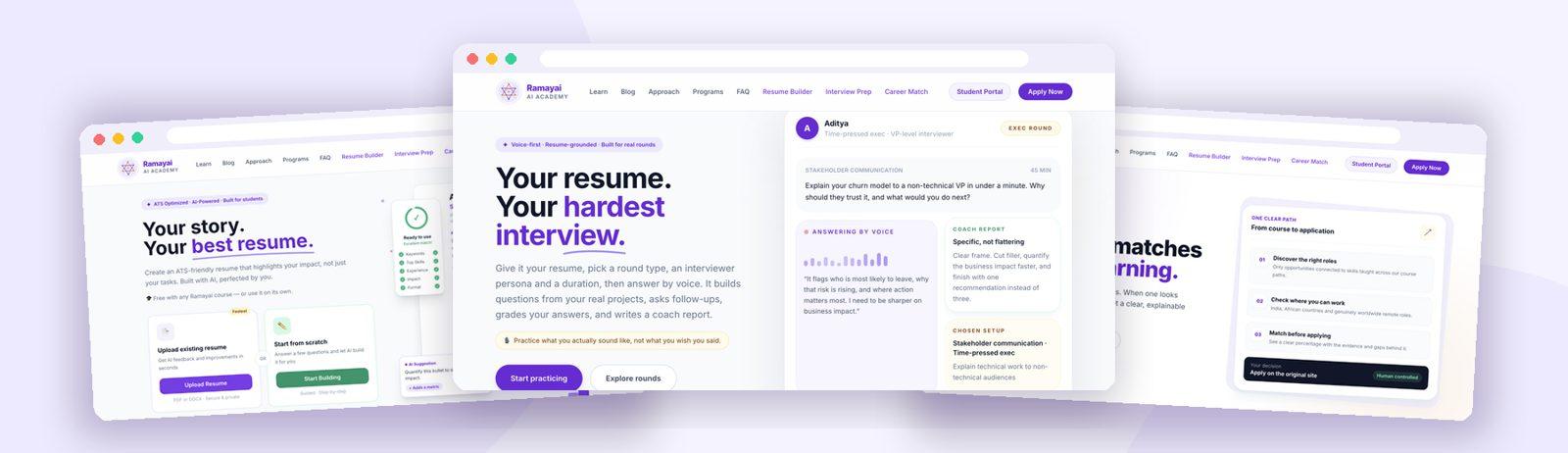
Resume Builder
Turns your four shipped systems into a resume tailored to each job description — and it is designed to use only experience you actually have.
🎙️Interview Prep
Runs voice mock interviews built from your own projects. It keeps drilling when an answer stays vague, then hands you a coach report on what broke down.
🎯Career Match
Shows live AI engineering jobs, matches them against your resume, and explains the gaps before you apply. You always apply yourself, on the employer’s own page.
The 5-month journey
Each month: a harder system, and a product you ship.
Real systems, not tutorial clones. Each month you build a complete AI system on a real problem, deploy it to a real URL, and prove it works with evals. You walk into interviews with four systems you can open and defend.
LLM + ML basics
How do models work?
M01 · Foundations
You ship: Tool-using agent
RAG
Knows your data?
M02 · Knowledge
You ship: Production RAG app
Multi-agent
Agents as a team?
M03 · Agent teams
You ship: Research assistant
Production
Ready for real users?
M04 · Capstone
You ship: A live AI product
Launch
Job search
M05 · Career Launch
You ship: Your portfolio
The four build months climb from a single agent to a production product: use tools, know your data, work as a team, survive real users. Month 5 turns everything you built into a job search.
Curriculum
Month by month, skill by skill.
Every skill is taught in four parts: the skill you can put on a resume, the concept behind it, a real problem you solve with it, and how you check that it works. You always build it from scratch first.
The skill
Structured outputs (Pydantic, Instructor)
The concept behind it
Typed responses instead of free text
A real problem it solves
Make the model return data your code can trust
How you check it
Schema validation rejects bad output
First you open the box: how LLMs work, how any model is trained and tested, and how to build one in PyTorch. Then your team wants an assistant that can search the codebase and docs and answer with citations — and you build it the hard way: the raw agent loop, with nothing hidden behind a framework.
Key Topics
- LLM foundations — tokens, embeddings, attention, transformers
- How LLMs are trained — pretraining, instruction tuning, RLHF
- ML foundations with scikit-learn — train, validate, test, overfitting
- PyTorch basics — tensors, gradients, a small neural network
- Calling models through an API; prompt patterns with a test set
- Structured outputs with Pydantic and Instructor
- Tool use and function calling
- The agent loop from scratch — perceive, decide, act, observe
- Context, caching and model routing across Claude, GPT and open models
Portfolio Project
Tool-using agent with citations — searches your files, runs code and answers with citations, returns structured output, works with any model, and logs every step.
LLM + ML foundations
How models work, PyTorch, scikit-learn
4 systems
Agent, RAG, multi-agent, production
Evals + tracing
Built in from Month 2
Job-ready
Portfolio, resume, interviews, applications
How you’ll learn
You build it from scratch first. Then frameworks make you fast.
Most AI courses start with a framework and never open the box. We start with the primitives. Every system climbs three steps — Scratch → Framework → Production — so you know exactly what every framework hides, and you can debug it when it breaks.
It starts with a real product problem
e.g. support questions pile up faster than the team can answer
From scratch
You write the agent loop yourself, no framework.
so you know exactly what frameworks hide
With a framework
Agent SDKs speed you up; you know what runs underneath.
so you move fast without magic boxes
In production
Evals, tracing and guardrails run on every change.
so it keeps working when real users arrive
You ship it
and prove it works with evals
Every module starts with a product problem, not an API. You never learn a library and then look for a use. You start with “why does the assistant make things up?” and learn the retrieval and evals that fix it.
Portfolio
The systems you will build and ship
Each month ends with a working AI system on a real URL — tested, traced and in your portfolio.
Tool-using agent with citations
- Build the agent loop from scratch — no framework
- Tool calling with structured outputs
- Context management and prompt caching
- Swap models through OpenRouter
In your portfolio
A GitHub repo, an architecture diagram, a 90-second demo video and a five-slide pitch.
Production RAG app
- Embedding and chunking pipeline
- Hybrid search with reranking
- Retrieval evals that catch regressions
- Chat UI on Vercel with tracing
In your portfolio
A live app, a GitHub repo, a retrieval-eval report, a demo video and a pitch.
Multi-agent research assistant
- Planner → search → writer → reviewer
- MCP tool servers your agents call
- Different models per agent
- Compared with a single-workflow baseline
In your portfolio
A GitHub repo, an architecture diagram, a pattern-comparison note, a demo video and a pitch.
A user-facing AI product
- A real user problem of your choice
- Evals in CI — quality drops fail the build
- Tracing and guardrails in production
- Cost dashboard and caching
In your portfolio
A live product, a GitHub repo, eval and cost reports, a demo video and a pitch. The project you open in every interview.
Your launch kit at graduation
Who is this course for?
If you already write code and want to build with AI, this course is for you.
AI engineering is open to anyone who can already code. You don’t need a research background or a machine-learning degree. You need to ship software — the course teaches the ML and LLM foundations, and the disciplines that make AI systems reliable.
Software engineers
Pivot into the highest-growth AI role with skills you already have
Senior data analysts and scientists
Move from analysis to building production AI systems
Backend and full-stack developers
Add agents, RAG and orchestration to your toolkit
Technical founders and tech leads
Understand the AI stack deeply enough to ship real products
CS and engineering graduates
Turn coding skills into a portfolio of shipped AI systems
QA, DevOps and data engineers
Bring your discipline to evals, tracing and deployment
You bring two or more years of coding; the course brings the AI engineering.
A week in the cohort
Build on weekdays. Learn live on weekends.
About 12–15 hours a week: 4 live hours at weekends plus 8–11 hours of build labs, built around a full-time job.
Weekday build labs
Short recorded lessons and hands-on labs, on your own schedule
Recorded, so any time zone works
Live class
2 hours
concepts and walkthroughs
Live build
2 hours
projects and Q&A together
Your instructor
Built by someone who has done the work
Instructor Photo
Saikumar Allaka
Head of AI at Okhi · Former Data Science Manager at Equity Bank & Safaricom
“Execution is cheap now. What hiring managers want is judgment: why this pattern, how you know it works, and what you did when it broke. That is what this course trains.
FAQ
Frequently asked questions
Who is this course for?+
Software engineers pivoting into AI, senior data analysts and scientists moving to agent engineering, and anyone with two or more years of professional coding. If you have never written code, start with The AI-Era Analyst instead.
How much time does it take each week?+
About 12–15 hours: two live sessions of 2 hours at the weekend, plus 8–11 hours of recorded lessons and build labs on your own schedule.
Do I need prior AI experience?+
No. We assume you can code in Python or TypeScript, have used an API and know Git. We don’t assume you have built an agent or know what RAG means — that is what we teach.
Why build from scratch before using frameworks?+
Because frameworks hide the parts that break. In Month 1 you write the agent loop yourself; frameworks come later as productivity tools, so you can debug them when something goes wrong.
What will I actually ship?+
Four AI systems on real URLs: a tool-using agent, a production RAG app, a multi-agent research assistant, and a capstone AI product with evals, tracing and guardrails — plus a portfolio site.
Which frameworks do you teach — am I locked in?+
One main stack — the Anthropic Agent SDK — taught in depth, with the OpenAI Agents SDK compared briefly and a short look at how the same ideas map to LangGraph. OpenRouter gives you access to many models, so there is no vendor lock-in.
Is this only about agents? What about ML and deep learning?+
Agents and AI products are the centre, because that is what most AI Engineer roles ask for. But Month 1 covers LLM and ML foundations — how transformers work, how models are trained and evaluated, scikit-learn and PyTorch — and you fine-tune models in PyTorch in Months 2 and 4. Deep ML research and training models from scratch are a different career.
Will I learn to fine-tune models?+
Yes. You fine-tune an embedding model for retrieval in Month 2 and an open model with PyTorch and LoRA in Month 4 — and learn when fine-tuning actually beats prompting and RAG.
How do I put this on my resume?+
Don’t list a job title you haven’t held. Lead with a target headline — “Applied AI Engineer | LLM Applications & RAG” — put the course under Education as “The AI-Era Agentic Engineer — Applied AI & Agentic Systems Certificate Program · 5 months”, and link your deployed projects with what you built and how you tested it. Month 5 helps you build all of it with the Resume Builder.
Is Week 1 free?+
Yes. Week 1 of the cohort is free — no credit card. You meet the instructor live, see the teaching, and decide whether to continue.
Is there a job guarantee? Do you help with placement?+
No. Nobody can honestly guarantee a job. What we guarantee is the work: four projects you can open and explain, a portfolio, and real interview practice. Then our team helps you get hired: resume and LinkedIn reviews, mock interviews, and referrals as we build our hiring network.
This certifies that
Your Name Here
has successfully completed
The AI-Era Agentic Engineer
Applied AI & Agentic Systems Certificate Program
On your resume
Lead with a target headline. Let your projects prove it.
Don’t claim a job title you haven’t held. Present the course like this:
Target headline
Applied AI Engineer | LLM Applications & RAG
Education
The AI-Era Agentic Engineer — Applied AI & Agentic Systems Certificate Program · 5 months
Projects
Shipped a tool-using agent, a production RAG app, a multi-agent system and an AI product with evals, tracing and guardrails.
Next cohort: February 2027 · Week 1 free
Anyone can call an AI model.
Become the engineer who ships it.
Five months. Four AI systems you build, test and ship — and a career launch to finish.