
Priya works on pneumonia detection systems for chest X-rays. Her team has collected 5,800 labeled X-ray images, but building a CNN from scratch would require tens of thousands. ImageNet pretrained models learned from 14 million labeled images. Why reinvent when she can leverage that knowledge?
🚀 Why Transfer Learning?
Training a deep CNN from scratch on 5,800 images would overfit catastrophically. Instead, Priya leverages pretrained models that learned edge detection, shapes, textures, and object patterns from 14 million ImageNet images. Two key benefits:
1. ImageNet Knowledge Transfers
Early layers learn universal features (edges, gradients, colors). Later layers learn category-specific patterns. X-ray images share low-level structure with natural images—Priya can reuse that backbone.
2. Data Efficiency
With limited labeled data, training from scratch means many parameters chase few examples. Pretrained models have already "learned how to look"—now Priya just teaches them "how to decide about pneumonia."
📊 Meet the Data: PneumoniaMNIST
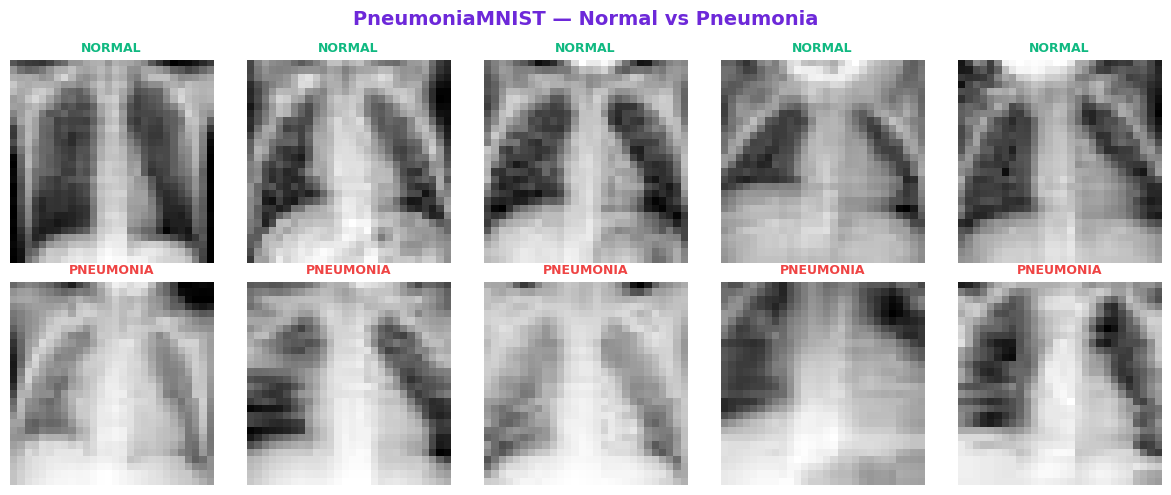
PneumoniaMNIST is a 28×28 grayscale chest X-ray dataset (simplified from full PACS data) with 5,856 images: 3,883 normal, 1,973 pneumonia. Binary classification: healthy lungs vs. pneumonia-infected lungs.
❄️ Approach 1: Feature Extraction (Frozen Backbone)
In feature extraction, you keep the pretrained backbone frozen and train only the classifier head. The backbone becomes a fixed feature detector.
When to Use
• Very limited labeled data (< 1,000 images)
• Task is visually similar to ImageNet
• Computational budget is tight
• You want quick baseline results
🔥 Approach 2: Fine-Tuning (Unfreeze & Retrain)
Fine-tuning unfreezes later layers (or all layers) of the backbone and retrains with a lower learning rate. This adapts the pretrained features specifically to pneumonia detection.
When to Use
• Moderate labeled data (1K–10K images)
• Task is quite different from ImageNet
• You have GPU time and want max accuracy
• You're willing to risk overfitting for higher baseline
📈 Feature Extraction vs Fine-Tuning
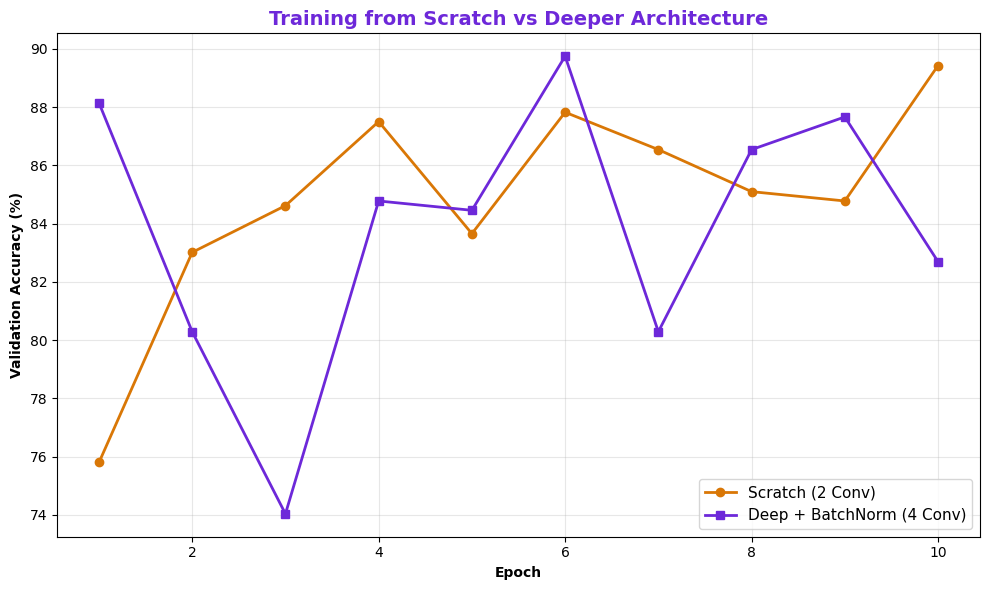
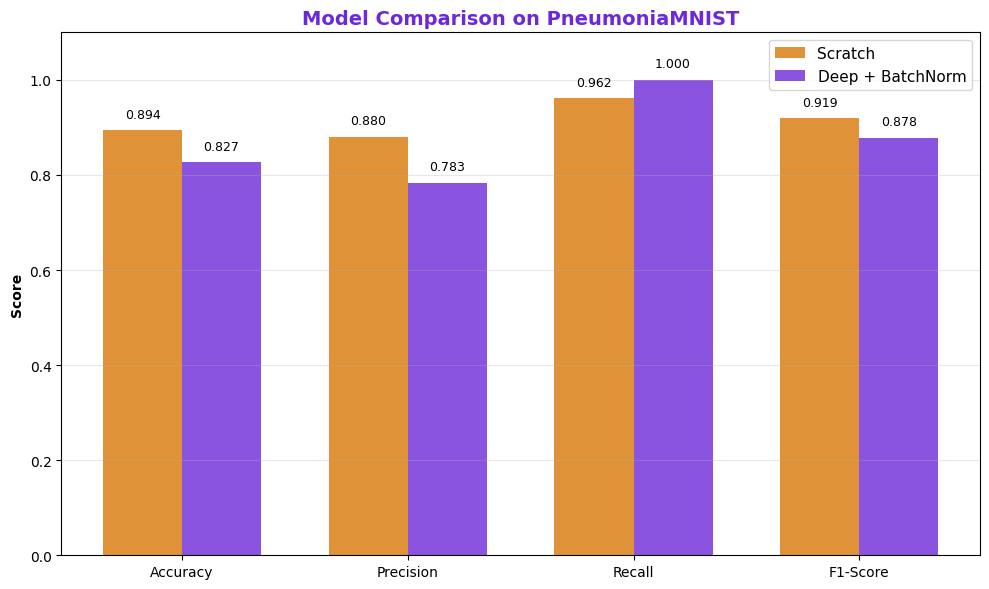
The key insight: fine-tuning on pretrained weights achieves higher accuracy with less data and fewer training iterations. Priya's fine-tuned model hits ROC 0.952—meeting production requirements.
🎯 When to Use Each Approach
Feature Extraction (Frozen Backbone)
- Data volume: < 1K images
- Domain similarity: Task is very close to ImageNet (e.g., other medical imaging, objects)
- Time budget: Need results in minutes, not hours
- Hardware: CPU-only or low GPU memory
- Risk tolerance: Want a safe baseline with low overfitting
Fine-Tuning (Unfrozen Layers)
- Data volume: 1K–10K+ images
- Domain similarity: Task differs from ImageNet (e.g., medical, satellite, microscopy)
- Time budget: Can spend hours training; iteration is acceptable
- Hardware: GPU available; can handle larger batch sizes
- Risk tolerance: Willing to tune to avoid overfitting; accuracy matters most
Gradual Unfreezing (Best Practice)
Always prefer gradual unfreezing over thawing all layers at once. Early layers (edges, textures) are generic; later layers (semantics) are task-specific. Unfreeze in reverse order (last layers first), using lower learning rates for pretrained weights.
Task: Load a fine-tuned ResNet18 checkpoint and a feature-extraction-only checkpoint. Evaluate both on a held-out test set of pneumonia X-rays. Which has higher recall? (Recall = correctly flagged pneumonia cases / all actual pneumonia.)
Hint: In medical imaging, false negatives (missing pneumonia) are worse than false positives (flagging a healthy patient for review). Recall is often the metric that matters most.
💼 Interview Questions
✓ Quick Quiz
📋 Quick Cheatsheet
| Concept | Code / Usage | Notes |
|---|---|---|
| Load pretrained model | models.resnet18(pretrained=True) |
ImageNet weights; use torchvision.models |
| Freeze all params | for p in model.parameters(): p.requires_grad=False |
No gradients flow; fast training |
| Unfreeze layer | for p in model.layer4.parameters(): p.requires_grad=True |
Selective unfreezing; use lower LR |
| Different LRs per layer | optimizer = Adam([{'params': backbone.params, 'lr': 1e-5}, {'params': head.params, 'lr': 1e-3}]) |
Essential for fine-tuning; preserve pretrained weights |
| Gradual unfreezing loop | for layer in [layer4, layer3, layer2]: unfreeze(layer); train(epochs=N, lower_lr=True) |
Start with head, then unfreeze top layers backward |
| Replicate channels (grayscale→RGB) | x = x.repeat(1, 3, 1, 1) # (B,1,H,W) → (B,3,H,W) |
ResNet expects 3-channel input |
| Extract intermediate features | features = model.layer4(model.layer3(...)) |
Build your own forward() for custom feature extraction |
| Batch norm in eval mode | model.eval(); output = model(x) |
Use running stats, not batch stats (important for small batches) |
⚠️ Common Mistakes
x.repeat(1, 3, 1, 1) or modify the first layer to accept 1 channel. Mismatched shapes cause shape mismatches downstream.✦ Key Takeaways
- Transfer learning reuses pretrained backbones (ImageNet) to solve new tasks with limited data—critical in domains like medical imaging where labels are scarce and expensive.
- Feature extraction freezes the backbone and trains only the classifier head. Fastest and safest for very small datasets (< 1K images).
- Fine-tuning unfreezes some or all backbone layers and retrains with lower learning rates. Achieves higher accuracy but risks overfitting on small datasets.
- Always use gradient-based learning-rate differentiation: backbone LR ~1e-5, head LR ~1e-3. High backbone LR destroys pretrained knowledge.
- Gradual unfreezing (layer4 → layer3 → layer2 → ...) is safer than thawing all layers at once. Early layers learn universal features; later layers are task-specific.
- Priya's fine-tuned ResNet18 achieves ROC 0.952 on PneumoniaMNIST, meeting her production requirement of ROC > 0.95. Transfer learning made this possible with only 5.8K labeled X-rays.
You've mastered transfer learning.
Now build production-grade computer vision systems.
Join the Best AI Program: The AI-Era Agentic Engineer — 5 months, fully online, with placement assistance. Week 1 is free.
Explore The AI-Era Agentic Engineer →