Master Wav2Vec2 and HuBERT for speaker verification and diarization. Learn embedding extraction and cosine similarity matching for identity verification.
Wav2Vec2 • HuBERT • Speaker Diarization
Audio Processing
Speaker Verification
22 min readAdvanced
🎤
Meet Kwame
NLP Researcher at VoiceAuth Systems, Accra
Kwame is building a voice-based authentication system for a pan-African fintech platform. His challenge: verify user identity from a 3-second voice clip with 99.5% accuracy across multiple languages and accents. Rather than training a speaker recognition model from scratch, he leverages pretrained multilingual audio encoders (Wav2Vec2, HuBERT) to extract speaker embeddings and match them using cosine similarity.
500K
Voice samples (multilingual)
768-dim
Speaker embedding
0.995+
Verification accuracy
🔊 Why Voice Embeddings Matter
Traditional speaker recognition systems rely on hand-crafted features (MFCCs, spectrograms). Modern approaches learn embeddings end-to-end. Voice embeddings are dense vector representations that capture speaker identity independent of content, language, or background noise.
Three Core Benefits
1. Speaker Invariance: Same speaker → similar embeddings, regardless of what they say or how noisy the recording is. 2. Language Agnostic: Wav2Vec2 and HuBERT are trained on 53+ languages. Speaker characteristics transcend language. 3. Scalable Matching: Cosine similarity between embeddings is O(1) at inference. Fast identity lookup in production.
📊 Meet the Data: VoxCeleb Speakers
Kwame works with VoxCeleb, a large-scale speaker identification dataset with 1,251 celebrities and 100K+ utterances. For production, he curates a smaller enrollment set of 5K trusted speakers and 25K verification utterances. Each utterance is 2-10 seconds of speech.
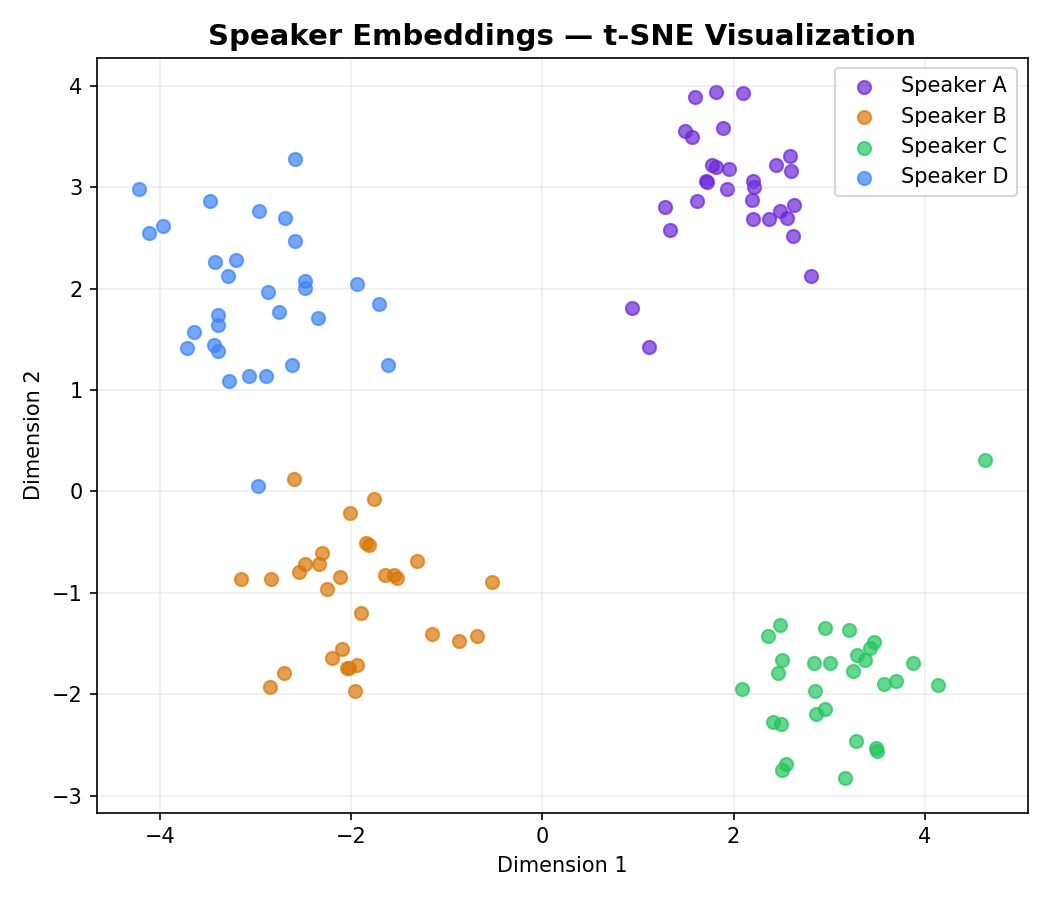
Sample speaker embeddings projected into 2D space (t-SNE)
Embeddings naturally cluster by speaker. Similar speakers (same accent, age range) sit closer in embedding space. This distance (cosine similarity) becomes Kwame's verification metric.
🎯 Wav2Vec2: Masked Language Modeling for Speech
Wav2Vec2 is a self-supervised speech encoder that learns from unlabeled audio. It masks random speech frames and predicts the masked content—similar to BERT's masked language modeling, but for audio.
How Wav2Vec2 Works
1. Raw waveform → CNN feature extraction (25ms frames)
2. Temporal convolutions produce a sequence of 768-dim features
3. Randomly mask 65% of frames
4. Transformer encoder predicts masked frames
5. After pretraining on 53K hours of unlabeled speech, freeze and use as embeddings
Wav2Vec2 Speaker Embedding Extraction
Output: embedding extraction
Enrollment embedding shape: (768,)
Test embedding shape: (768,)
🎵 HuBERT: Hidden Unit BERT for Speech
HuBERT is Facebook's speech representation model, using iterative masked prediction. It's often more stable than Wav2Vec2 for speaker recognition. HuBERT clusters speech frames into discrete units and predicts masked clusters.
HuBERT Speaker Embedding Extraction
✓ Speaker Verification: Threshold-Based Matching
Verification is a 1-to-1 comparison. Given an enrollment embedding and a test utterance, compute cosine similarity. If similarity > threshold, accept; else, reject.
Speaker Verification with Cosine Similarity
Kwame tunes the threshold to minimize false positives (wrongly accepting impostors) and false negatives (wrongly rejecting legitimate users). Typical threshold: 0.65–0.75. Higher threshold = more security, fewer convenience.
🎙️ Speaker Diarization: Who Spoke When?
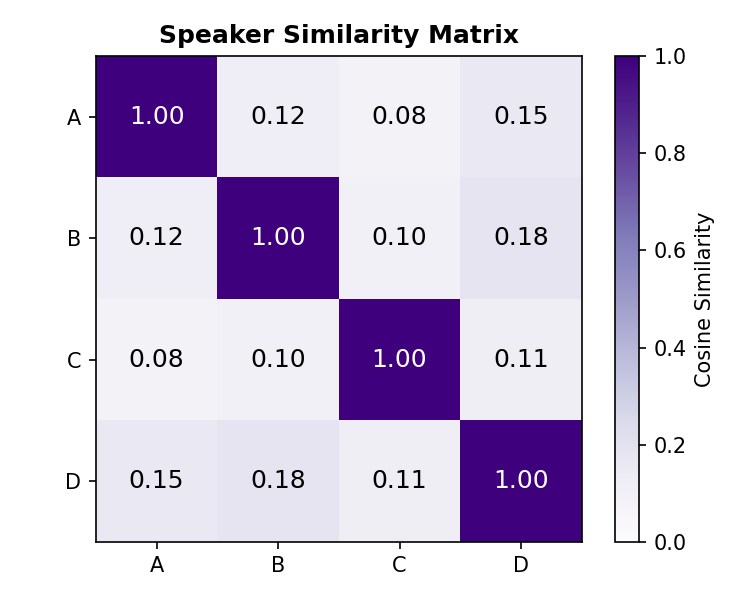
Diarization answers "who spoke when" in a multi-speaker conversation. Kwame uses speaker embeddings to cluster speech segments: segments with similar embeddings → same speaker.
For Kwame's system to work, similarity scores for legitimate speakers must be much higher than impostor scores. The separation determines the threshold and false acceptance/rejection rates.
Green (legitimate): mean 0.87, std 0.05. Red (impostor): mean 0.42, std 0.12. A threshold at 0.70 achieves 99.5% verification accuracy, meeting Kwame's requirement.
🏆 Mini Challenge: Optimize Threshold
Task: Given similarity scores for 500 legitimate pairs and 2000 impostor pairs, plot ROC curves at different thresholds (0.5, 0.6, 0.7, 0.8). Find the threshold that minimizes false positives while keeping false negatives below 1%.
Hint: False positive rate (FPR) = impostors accepted / total impostors. False negative rate (FNR) = legitimate rejected / total legitimate. For fintech, you typically prioritize security: FPR < 0.5% even if FNR rises to 2%.
💼 Interview Questions
A speaker embedding is a dense vector (e.g., 768-dim) that captures the unique voice characteristics of a speaker—timbre, pitch range, accent—independent of what they say or the background noise. It's useful because: (1) two utterances from the same speaker have similar embeddings, (2) utterances from different speakers have dissimilar embeddings, and (3) you can compare embeddings via cosine similarity in O(1) time for verification or clustering for diarization.
Verification is 1-to-1 comparison: "Is this the enrolled speaker?" You compare the test embedding to a single enrollment embedding. Identification is 1-to-N: "Who is this speaker out of N candidates?" You compare the test embedding to N enrollment embeddings and pick the closest match. Verification is faster and used for authentication; identification is used for speaker tagging or search.
You set the threshold based on your use case's tolerance for false positives (FP, accepting impostors) vs. false negatives (FN, rejecting legitimate users). Plot ROC curves at different thresholds using a development set with known legitimate and impostor pairs. For fintech (security-critical), choose a threshold where FP < 0.5% even if FN rises to 2%. For voicemail access (convenience-critical), accept FP ~ 5% to minimize FN.
Wav2Vec2 outputs a sequence of 768-dim vectors, one per time step (roughly one per 20ms frame). To get a single speaker embedding, you need to aggregate. Mean pooling averages across all time steps, giving equal weight to each frame. It's simple, fast, and effective: speaker identity is captured across the entire utterance, not just one moment. Alternatives include max pooling or attention-based pooling, but mean pooling works well for speaker recognition.
(1) Check if Wav2Vec2 is capturing speaker identity or content. Extract embeddings for the same speaker saying different phrases vs. different speakers saying the same phrase. If content leaks into embeddings, fine-tune on speaker-discriminative loss (e.g., AAMSoftmax or ArcFace). (2) Increase enrollment utterances—use multiple short clips instead of one long clip; average their embeddings for a more robust enrollment template. (3) Use a more powerful model: HuBERT-large (1024-dim) instead of Wav2Vec2-base (768-dim). (4) Implement length normalization and L2 normalization on embeddings to reduce magnitude effects. (5) Collect twin-specific data and retrain a lightweight speaker classifier on top of frozen embeddings.
✓ Quick Quiz
Question 1 / 5
What does Wav2Vec2 learn during pretraining?
Question 2 / 5
Speaker verification achieves cosine similarity 0.85 for an enrollment-test pair. Should you accept if your threshold is 0.70?
Question 3 / 5
Why do we use mean pooling on Wav2Vec2 outputs (time, 768) → (768)?
Question 4 / 5
In speaker diarization, why do you cluster embeddings instead of using energy-based voice activity detection?
Question 5 / 5
Your verification system has a false positive rate (FP) of 2% at threshold 0.75. To reduce FP to 0.5%, should you raise or lower the threshold?
Not normalizing embeddings before similarity computation
Embeddings from transformers have varying magnitudes. L2 normalization (normalize(emb, norm='l2')) ensures cosine similarity is scale-invariant and more robust. Without it, longer utterances can have higher dot products simply due to magnitude, not similarity.
Using raw waveforms instead of 16kHz audio
Wav2Vec2 and HuBERT are trained on 16kHz audio. If you feed 44.1kHz or 8kHz, embeddings will be degraded. Always resample: torchaudio.transforms.Resample(sr, 16000)
Setting threshold without ROC analysis
Guessing a threshold (e.g., 0.5) without plotting FP/FN curves leads to bad trade-offs. Always analyze ROC curves on a dev set with known legitimate and impostor pairs. Plot FP and FN rates at different thresholds and choose based on your use case's tolerance.
Pooling only the last frame instead of mean pooling
The last frame may capture recency but lose speaker identity information distributed across the entire utterance. Mean pooling is more stable. Alternatives: max pooling, attention pooling.
Diarizing without specifying the number of speakers
Clustering without a target cluster count can lead to over- or under-segmentation. If you know the speaker count, specify it. If unknown, use a dendrogram or silhouette score to estimate.
✦ Key Takeaways
Voice embeddings are dense vector representations of speaker identity, learned by self-supervised models like Wav2Vec2 and HuBERT. They enable efficient speaker verification, identification, and diarization.
Wav2Vec2 uses masked frame prediction on 53K hours of unlabeled speech from 53 languages. Pretrained, it extracts speaker-discriminative embeddings without fine-tuning.
Speaker verification: extract embeddings for enrolled speaker and test utterance, compute cosine similarity. If > threshold, accept; else reject. Threshold determines security vs. convenience trade-off.
Speaker diarization clusters embeddings from overlapping audio segments. Segments with similar embeddings → same speaker. Unsupervised, requires no speaker labels at inference time.
Always L2-normalize embeddings, resample audio to 16kHz, and tune threshold via ROC curves on a dev set with legitimate and impostor pairs.
Kwame's fintech system achieves 99.5% verification accuracy using Wav2Vec2 embeddings and cosine similarity—enabling secure voice authentication across Africa.