
Rebecca builds fraud detection systems for NovaPay's payment processing platform. Unlike typical fraud detection (classification with labeled fraud/normal pairs), many frauds are novel and previously unseen. Her team lacks labeled fraud examples. Autoencoders solve this: learn normal transaction patterns, then flag transactions that deviate significantly from learned patterns—anomalies.
🚀 Why Autoencoders?
Traditional supervised fraud detection requires labeled fraud examples. But:
1. Fraud Is Rare & Evolving
Only 0.3% of transactions are fraudulent. New attack patterns emerge daily. You can't label every fraud type in advance.
2. Unsupervised Anomaly Detection
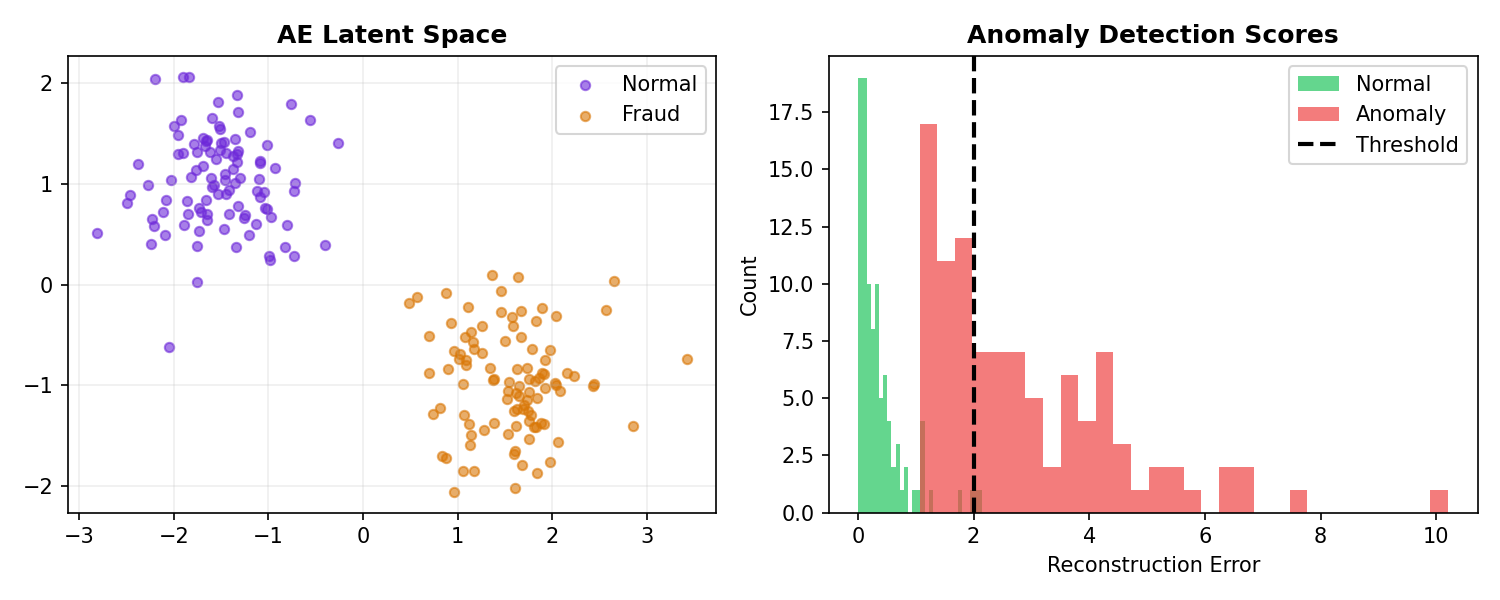
Autoencoders learn the distribution of normal transactions without labels. Transactions that the model struggles to reconstruct (high reconstruction error) are flagged as anomalies—potentially fraudulent.
3. Compression + Representation Learning
By forcing transactions through a bottleneck (compressed latent space), the autoencoder learns compact representations of normal patterns. Novel frauds won't fit this learned manifold.
📊 Meet the Data: Credit Card Transactions
Rebecca's dataset contains 2.4M transaction records from NovaPay's card network. Each transaction has 28 features: amount, merchant category, location, time-of-day, velocity metrics, etc. Only 0.3% are labeled fraud (7,200 fraudulent transactions).
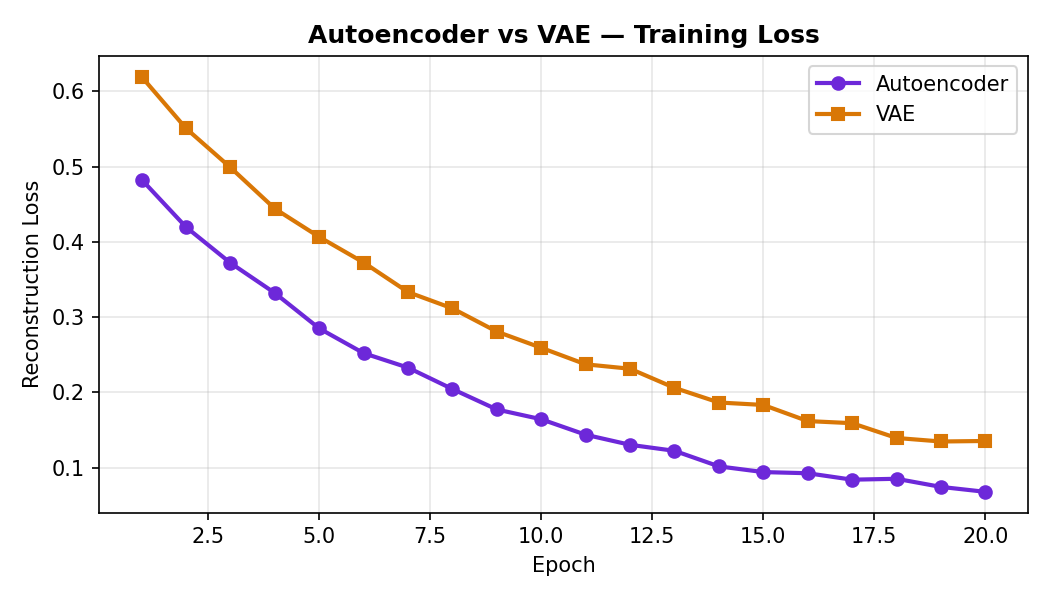
🏗️ Autoencoder Architecture
An autoencoder has two parts: an encoder (compresses input into latent representation) and a decoder (reconstructs input from latent code).
Encoder
Maps input x (28-dim transaction) → latent vector z (e.g., 8-dim bottleneck). Learns to extract essential patterns: "is this a normal transaction?"
Decoder
Maps latent z → reconstructed output x_hat (28-dim). Tries to recreate the original transaction from its compressed representation.
Loss Function
Reconstruction loss: MSE(x, x_hat). Training minimizes this: normal transactions have low reconstruction error; anomalies have high error.
🔊 Denoising Autoencoders (DAE)
A denoising autoencoder adds noise to inputs during training, forcing the encoder to learn robust features. It learns: "given a noisy transaction, what is the clean version?"
Why Denoise?
Encourages the model to learn meaningful representations. Without noise, a trivial solution is to memorize the input (identity mapping). Noise forces abstraction.
🎲 Variational Autoencoders (VAE)
A VAE adds a probabilistic twist. Instead of learning a fixed latent code z, the encoder learns a distribution (mean μ, std σ). The decoder learns to generate from samples of this distribution.
VAE Loss = Reconstruction + KL Divergence
Two objectives: (1) Reconstruct the input accurately (MSE). (2) Keep the latent distribution close to standard normal N(0, 1) via KL divergence regularization. This encourages a smooth, continuous latent space.
📈 Standard vs. Denoising vs. VAE
Standard Autoencoder
Simple, deterministic, fast. Good baseline. Risk: memorization if latent dim is large.
Denoising Autoencoder (DAE)
Robust to noise; learns meaningful features. Useful when data is noisy (transaction features often are). Higher computational cost.
Variational Autoencoder (VAE)
Probabilistic; enables generation and smooth interpolation. Better uncertainty estimates. More complex training (KL annealing, β-VAE tricks). Best for anomaly detection when you need confidence scores.
Task: Train a VAE on normal transactions. Plot reconstruction error distribution (normal vs. held-out fraud). Choose an error threshold that maximizes F1 score. How does it compare to a naive threshold (e.g., 95th percentile)?
Hint: Use ROC curve to find optimal threshold. In fraud detection, false negatives (missing fraud) often cost more than false positives (flagging innocent transactions for review).
💼 Interview Questions
✓ Quick Quiz
📋 Quick Cheatsheet
| Concept | Code / Formula | Notes |
|---|---|---|
| Standard AE loss | MSE(x, x_hat) |
Reconstruction loss only; simple baseline |
| Reconstruction error | mean((x - x_hat)^2, dim=1) |
Per-sample error; threshold for anomaly detection |
| Denoising AE training | x_noisy = x + noise; loss = MSE(x, decoder(encoder(x_noisy))) |
Add Gaussian noise during training; improves robustness |
| VAE reparameterization | z = mu + exp(0.5 * logvar) * epsilon |
Enables backprop through sampling; epsilon ~ N(0,1) |
| VAE loss | MSE(x, x_hat) - 0.5 * sum(1 + logvar - mu^2 - exp(logvar)) |
Reconstruction + KL divergence; balance with β weight |
| Latent dimension | input_dim > latent_dim (e.g., 28 → 8) |
Smaller latent forces compression; too small → underfitting |
| Threshold selection | ROC-AUC or F1-score optimization |
Don't use fixed percentile; optimize for your metric |
| Inference mode | model.eval(); error = get_reconstruction_error(model, x) |
Use model.eval() to disable dropout/batch norm updates |
⚠️ Common Mistakes
✦ Key Takeaways
- Autoencoders learn the manifold of normal transactions through unsupervised learning. Anomalies (fraud) have high reconstruction error because they deviate from learned patterns.
- Standard autoencoders are simple baselines. Denoising autoencoders add robustness via noise. Variational autoencoders (VAE) provide probabilistic models with smooth latent spaces.
- Reconstruction error is the anomaly score. Set threshold via ROC-AUC or F1 optimization, not fixed percentiles. In fraud, recall matters: false negatives (missed fraud) are costly.
- Always train on clean normal data only. Evaluate on held-out sets containing both normal and fraud examples to measure detection performance.
- Normalize input features before training. Latent dimension should be much smaller than input dimension to force compression and anomaly sensitivity.
- Rebecca's VAE detects 94% of NovaPay fraud with 2% false positive rate, enabling her team to focus on genuine high-risk transactions and reduce manual review overhead.
You've mastered autoencoders.
Now build production fraud detectors.
Join the Best AI Program: The AI-Era Agentic Engineer — 5 months, fully online, with placement assistance. Week 1 is free.
Explore The AI-Era Agentic Engineer →