
Arjun is an AI engineer at MedScan Diagnostics in Hyderabad, a healthcare AI startup. His team has built a deep learning model to detect tumors in CT scans with 95% accuracy. Tomorrow, he pitches to the hospital board. But the chief medical officer asks: "Why deep learning? Why not statistical models? And why now—why didn't this work 20 years ago?"
Arjun realizes he needs to explain not just the code, but the history. Why did Perceptrons fail? How did the 1969 AI Winter last 17 years? What changed in 2012 that made everything possible? Understanding the past is the key to explaining the present and building the future.
Era 1: The Birth (1957)
In 1957, Frank Rosenblatt built the Perceptron at Cornell University—the first artificial neuron that could learn. It mimicked a single neuron in the brain: take weighted inputs, apply a threshold, output a decision. Rosenblatt's Perceptron trained itself to recognize simple patterns by adjusting weights. The world was amazed.
The breakthrough: An algorithm that learns without being explicitly programmed. The Perceptron proved Turing's dream: machines that adapt. Newspapers called it "the beginning of electronic brain." Rosenblatt was confident: "The perceptron may eventually be able to learn, make decisions, and translate languages."
The limitation: It couldn't solve the XOR problem. XOR is simple to humans—"True if inputs differ, False if they're the same"—but a single-layer Perceptron cannot draw a line separating the two classes. This limitation would haunt deep learning for 29 years.
Era 2: The Critique & AI Winter (1969–1986)
In 1969, Marvin Minsky and Seymour Papert published "Perceptrons: An Introduction to Computational Geometry." They proved mathematically that single-layer networks cannot learn nonlinear functions like XOR. Their book was devastating—not because it was wrong, but because it was right, and funding agencies believed it.
The winter arrived: Funding dried up. Top researchers left AI. Expectations had been too high ("AI will match human intelligence in a generation") and progress was too slow. The 17-year winter (1969–1986) is AI's darkest chapter.
Why the winter lasted so long
- Theory was incomplete: Minsky & Papert proved the limitation but didn't prove a solution existed. Multi-layer networks *could* learn XOR, but how to train them? That question went unanswered for 17 years.
- Computing was too slow: Even if you had the algorithm, training a network on 1960s computers would take months. No researcher dared try.
- No large datasets: Deep learning needs data. In 1970, digitizing images was manual work. ImageNet, which has 1.2M images, didn't exist until 2010.
- Expectations collapse: Overpromise and underdeliver is fatal in research funding. AI promised too much in the 1960s and delivered too little in the 1970s. Trust evaporated.
Era 3: Rebirth — Backpropagation (1986)
In 1986, David Rumelhart, Geoffrey Hinton, and Ronald Williams rediscovered (and popularized) backpropagation—an algorithm that efficiently trains multi-layer networks. Backpropagation is elegant: compute the error at the output, then propagate that error backward through the network, adjusting weights at each layer.
The magic: Suddenly, networks with 3, 4, or more layers could learn XOR, and other nonlinear problems. The AI Winter ended. Funding returned. The field called it the "Connectionist Renaissance."
Why it took so long to rediscover: Backpropagation was published in obscure papers in 1974 by Paul Werbos, but the deep learning community didn't know. In 1986, Rumelhart & Hinton proved it worked at scale and published it in a top journal. Same algorithm, better visibility—and the timing was right. Computing was faster, datasets were bigger, and the field was hungry.
Era 4: Early Promise (1998–2005)
In 1998, Yann LeCun built LeNet-5, a convolutional neural network (CNN) that recognized handwritten digits with 99% accuracy. It shipped in production: bank check readers used LeNet-5 to process millions of checks. Deep learning was no longer just theory—it was working in the real world.
The innovation: Convolutional layers (filters that scan images locally) + pooling (compress information). This architecture is biologically inspired and computationally efficient. LeNet-5 proved that deep learning could solve real problems.
The plateau: Despite LeNet's success, progress was slow. CNNs worked for images, but scaling to larger networks was hard. Training took weeks on top-of-the-line GPUs (which didn't exist yet—these were CPUs). And datasets were still small.
Era 5: Deep Belief Nets (2006)
In 2006, Geoffrey Hinton published a breakthrough: Deep Belief Nets (DBNs). Instead of training a deep network all at once (which led to vanishing gradients—a problem where error signals get too small in deeper layers), Hinton proposed layer-by-layer pretraining. Train the first layer unsupervised, freeze it, train the next layer on top, repeat.
The insight: Deep networks don't have to fail. You just need to initialize weights carefully. Hinton's approach proved you could train networks with 10+ layers, much deeper than before.
The impact: The field shifted. Deep learning—literally, deep networks—became possible and popular. Funding agencies and industry noticed. Top researchers who left AI in the 1980s started returning.
Era 6: The Modern Era (2012–2024)
Everything changed on September 30, 2012. Geoffrey Hinton's team won the ImageNet competition with AlexNet, a deep convolutional network. The error rate dropped from 26% (previous year) to 15%. A 41% relative improvement in a single year. The results were so shocking that other teams demanded a recount.
AlexNet's innovations: ReLU activation (faster, avoids vanishing gradients), dropout (prevents overfitting), GPU training (10x speedup), and aggressive data augmentation. Each piece was small, but together they proved deep learning at scale was real.
Parameter explosion: from 2 neurons to 1.8 trillion
The Perceptron had one neuron. AlexNet (2012) had 60 million parameters. GPT-4 (2024) has 1.8 trillion. The growth is exponential, but not random. Each milestone enabled the next: more parameters needed more data, more compute, and better algorithms.
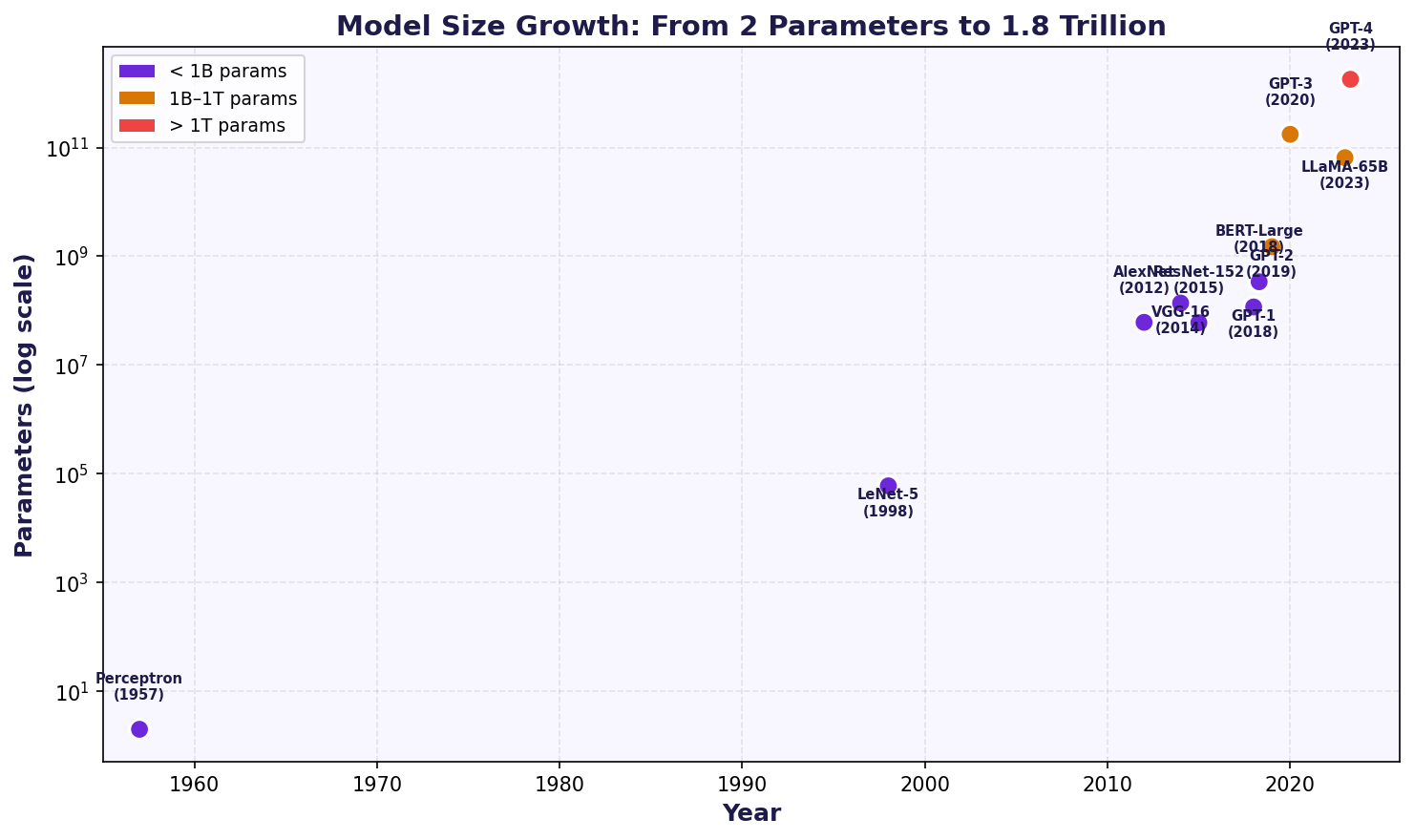
Why the explosion? Four enablers converged:
Why the explosion? Four enablers
Enabler 1: Computing Power
GPUs (Graphics Processing Units) are perfect for neural networks. They have thousands of tiny cores built for matrix math. NVIDIA released CUDA in 2006, making GPU programming easy. By 2012, training a CNN on a GPU was 10x faster than CPU. By 2022, scaling to 100+ GPUs meant training billion-parameter models overnight.
Enabler 2: Data at Scale
ImageNet (2010) had 1.2 million labeled images. The internet made data collection possible. Now, datasets like Common Crawl have 2 trillion web pages. Large language models train on all of human text. Data abundance is a feature, not a limitation.
Enabler 3: Algorithmic Innovations
ReLU (2011) avoids vanishing gradients. Batch Normalization (2015) stabilizes training. Residual connections (2015) allow 100+ layer networks. Attention mechanisms (2017) enable parallel training and transformers. Each innovation made training deeper, wider, and faster networks possible.
Enabler 4: Talent Migration
Top researchers moved from academia to industry. Geoffrey Hinton joined Google. Yann LeCun joined Facebook. Andrew Ng founded Coursera then partnered with industry. With top talent focused on deep learning, progress accelerated exponentially.
Three pillars of deep learning
Modern deep learning dominates three domains:
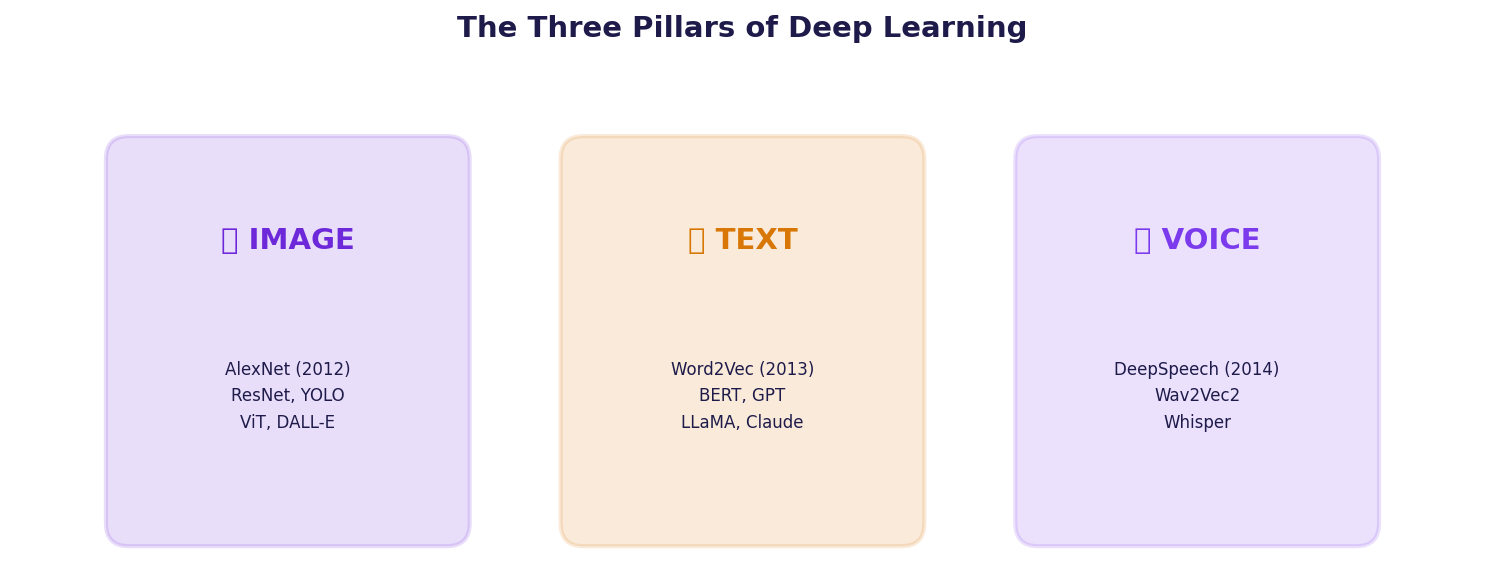
Vision (CNNs): Images, video, medical imaging. MedScan's tumor detection uses CNNs. Convolutional layers efficiently process spatial information.
Language (Transformers): Text, translation, chatbots. GPT-4, Claude, Gemini are transformer-based. Attention mechanisms allow the model to focus on relevant words.
Audio (RNNs + Attention): Speech recognition, music generation, voice assistants. Recurrent layers process sequences. Transformers are increasingly used here too.
Modern milestones (2012–2024): a decade of transformation
2014: GANs (Generative Adversarial Networks)
Ian Goodfellow introduced GANs. Two networks compete: one generates fake images, the other tries to detect fakes. The generator learns to fool the discriminator. Result: AI can now generate realistic images, art, and faces. This opened a new frontier.
2016: AlphaGo beats Lee Sedol
DeepMind's AlphaGo, powered by deep neural networks + reinforcement learning, beat world champion Lee Sedol at Go—a game with more possible positions than atoms in the universe. Experts said AI would need 10+ more years. AlphaGo proved that deep learning + game-playing could achieve superhuman performance.
2017: Transformers (Attention Is All You Need)
A paper by Vaswani et al. introduced Transformers. Instead of recurrent layers (which are slow), Transformers use attention: each word attends to all other words in parallel. Training is 10x faster. Transformers became the foundation for all modern language models.
2018: BERT & GPT — The Transfer Learning Era Begins
BERT (Google) and GPT (OpenAI) proved a powerful paradigm: pretrain on massive unlabeled data, then finetune on specific tasks. You train once, deploy everywhere. This approach dominates machine learning today.
2022: ChatGPT — AI Goes Mainstream
OpenAI released ChatGPT, a chat interface to GPT-3.5. It reached 100 million users in 2 months—faster than any software ever. Suddenly, AI wasn't for researchers; it was for everyone. This moment legitimized the field and triggered a wave of investment and competition.
2024: Open Models, LoRA, MoE, and Agents
Open models (Llama 3, Mixtral, Falcon) made state-of-the-art AI accessible. LoRA (Low-Rank Adaptation) let anyone finetune large models on a laptop. Mixture of Experts (MoE) scaled models to trillions of parameters efficiently. AI agents (systems that plan and act autonomously) started solving real problems. The field transitioned from research to production.
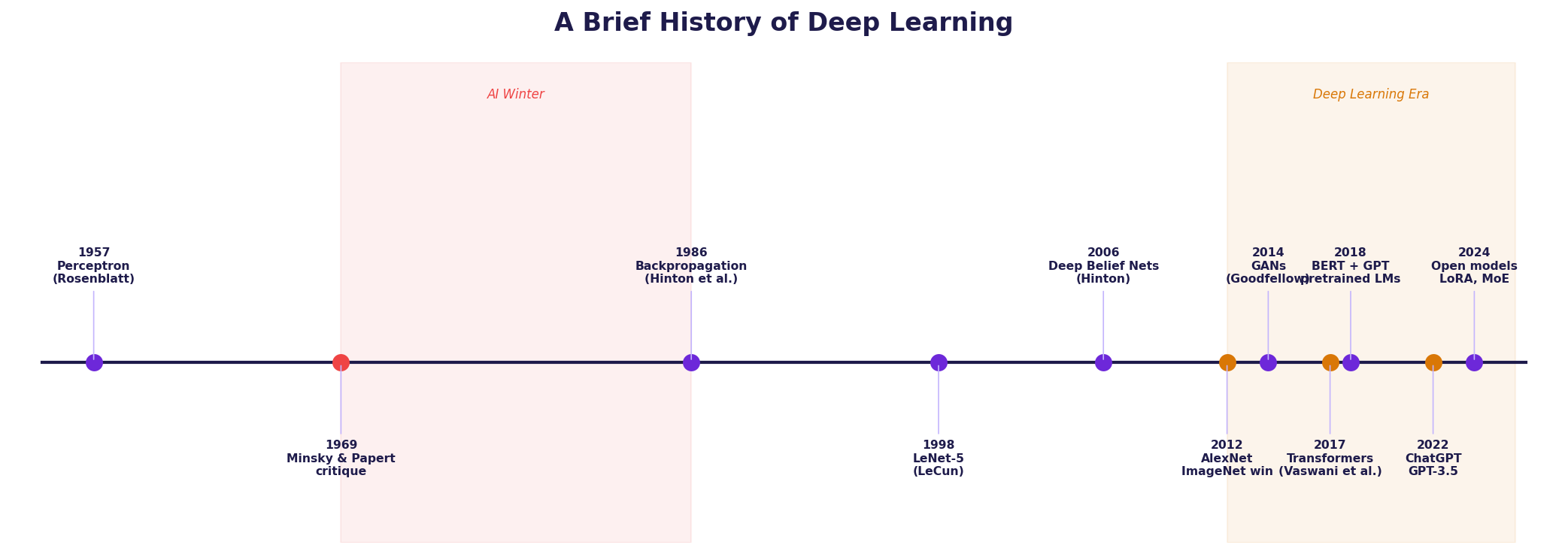
Complete timeline: 1957–2024
Also used in...
Domain Spotlight
How this history shapes today's AI
Every AI assistant you interact with—ChatGPT, Copilot, Gemini, Midjourney—stands on the shoulders of 67 years of research. The transformer in GPT-4 descends from McCulloch-Pitts neurons (1943). The backpropagation that trained your phone's face unlock came from 1986. The attention mechanisms that power language models emerged from the same mathematical principles Rosenblatt discovered: learn by adjusting weights.
Understanding this history isn't nostalgia. It's practical. When you see a new paper on diffusion models or retrieval-augmented generation, you'll recognize it as an evolution of the same 67-year journey. When you build systems at MedScan or scale models at a startup, you'll know which innovations matter and why. History repeats—and that's a feature, not a bug.
Interview questions: test your understanding
Quiz: 5 questions to test your knowledge
Cheatsheet: deep learning timeline at a glance
| Year | Event | Impact |
|---|---|---|
| 1957 | Perceptron (Rosenblatt) | First artificial neuron that learns |
| 1969 | Perceptrons book (Minsky & Papert) | Proved single-layer networks can't learn XOR. AI Winter begins. |
| 1986 | Backpropagation (Rumelhart, Hinton, Williams) | Efficient training of multi-layer networks. AI Winter ends. |
| 1998 | LeNet-5 (Yann LeCun) | CNNs recognize handwritten digits in production. Deep learning works. |
| 2006 | Deep Belief Nets (Hinton) | Layer-by-layer pretraining enables training 10+ layer networks. |
| 2012 | AlexNet wins ImageNet | 41% error drop in 1 year. Modern deep learning era begins. |
| 2014 | GANs (Ian Goodfellow) | Generative models. AI can create realistic images. |
| 2016 | AlphaGo beats Lee Sedol | Deep learning + RL = superhuman game playing. Field accelerates. |
| 2017 | Transformers (Vaswani et al.) | Parallel training, efficient scaling. Foundation of GPT. |
| 2018 | BERT & GPT (Google & OpenAI) | Pretrain-then-finetune paradigm. Transfer learning becomes standard. |
| 2022 | ChatGPT launch | 100M users in 2 months. AI goes mainstream. |
| 2024 | Open models, LoRA, MoE, agents | Accessible AI. Efficient fine-tuning. Production systems scale. |
Common mistakes: misconceptions about deep learning history
Key takeaways
Understanding deep learning's history isn't academic—it's practical wisdom for building tomorrow's systems.
- Theory precedes practice: Backpropagation was theoretically possible since 1974. But it took until 1986 for computing and datasets to catch up. Today's "impossibilities" might be tomorrow's breakthroughs.
- Progress is nonlinear: The AI Winter lasted 17 years. But when it ended, progress accelerated. From 2012 onward, expect exponential growth interrupted by occasional winters.
- Algorithms > hardware: GPU speedup was the enabler, not the innovation. AlexNet's brilliance was architectural: ReLU, dropout, data augmentation.
- Convergence is key: Four enablers (compute, data, algorithms, talent) had to converge. Missing one, and deep learning wouldn't have exploded. Building tomorrow's AI means focusing on all four.
- History informs strategy: The transformer revolution (2017) mirrors the CNN revolution (2012). Both were incremental improvements that became paradigm shifts. When you see the next "incremental" innovation, ask: is this the next transformer?
You've traced 67 years of deep learning history.
Now build the next chapter yourself.
Join the Best AI Program: The AI-Era Agentic Engineer — 5 months, fully online, with placement assistance. Week 1 is free.
Explore The AI-Era Agentic Engineer →