
Priya builds diagnostic systems that analyze retinal fundus images to detect diabetic retinopathy (DR). Her CNN baseline (ResNet50) achieves 0.89 AUC on her test set. But CNNs have limitations: they struggle with global context (a critical hemorrhage might be far from local edges) and require many parameters for high resolution images. She's exploring Vision Transformers: apply transformer self-attention directly to image patches, enabling fine-grained, global analysis of the retina.
🚀 Why Vision Transformers?
CNNs use local convolution windows; good for low-level features but limited global context. Transformers use self-attention over all image regions, enabling:
1. Global Receptive Field
Each token attends to all other tokens (all image patches). Hemorrhages or microaneurysms far apart can be directly compared—critical for DR diagnosis.
2. Interpretability
Attention weights show which patches influenced the prediction. Priya can visualize: "the classifier paid attention to this hemorrhage region and this cotton-wool spot."
3. Scalability
ViT scales to high-resolution images efficiently. CNNs' spatial dimensions explode with resolution; ViT patches abstract spatial dimensions.
📊 Meet the Data: Diabetic Retinopathy
Priya's dataset: 12K retinal fundus images (512×512 RGB) from diabetic patients and controls. Task: binary classification (DR present/absent). Real-world complication: severe class imbalance (70% normal, 30% DR).
🏗️ Vision Transformer (ViT) Architecture
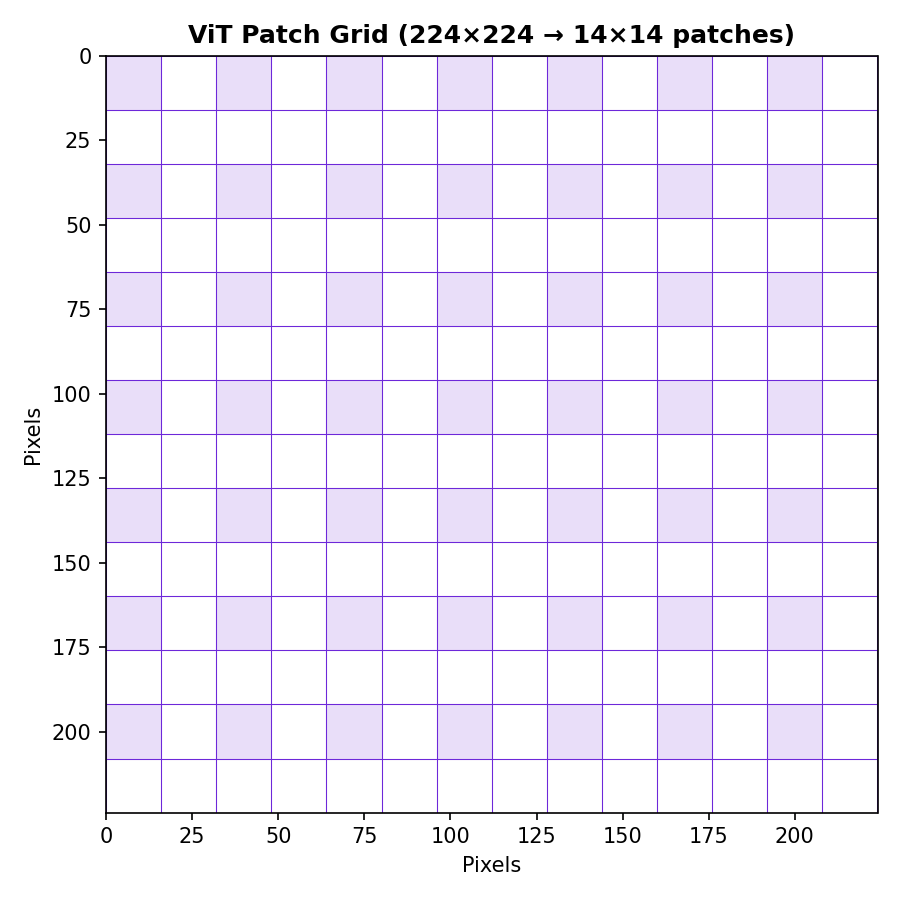
ViT reformulates image classification as a sequence-to-sequence problem. Step 1: split image into patches. Step 2: embed patches. Step 3: apply transformer encoder. Step 4: classify from [CLS] token.
Patch Embedding
Image (H, W, C) → patches of size P×P → flatten each patch → linear projection to embedding dimension D. E.g., 512×512 RGB image with 16×16 patches → 1,024 patches → 1,024 × 768-dim embeddings.
Position Embedding
Transformers are permutation-invariant. Add learnable position embeddings to preserve spatial structure. Along with [CLS] token (summary token), total sequence: 1,025 tokens (1 [CLS] + 1,024 patches).
Transformer Encoder
L layers of multi-head self-attention + MLP. Each token attends to all tokens (global context). Output: contextualized patch embeddings.
👁️ Attention Visualization & Interpretability
One advantage of ViT over CNNs: attention weights are directly interpretable. Priya can visualize which image patches influenced the prediction.
⚡ DeiT: Efficient Vision Transformers
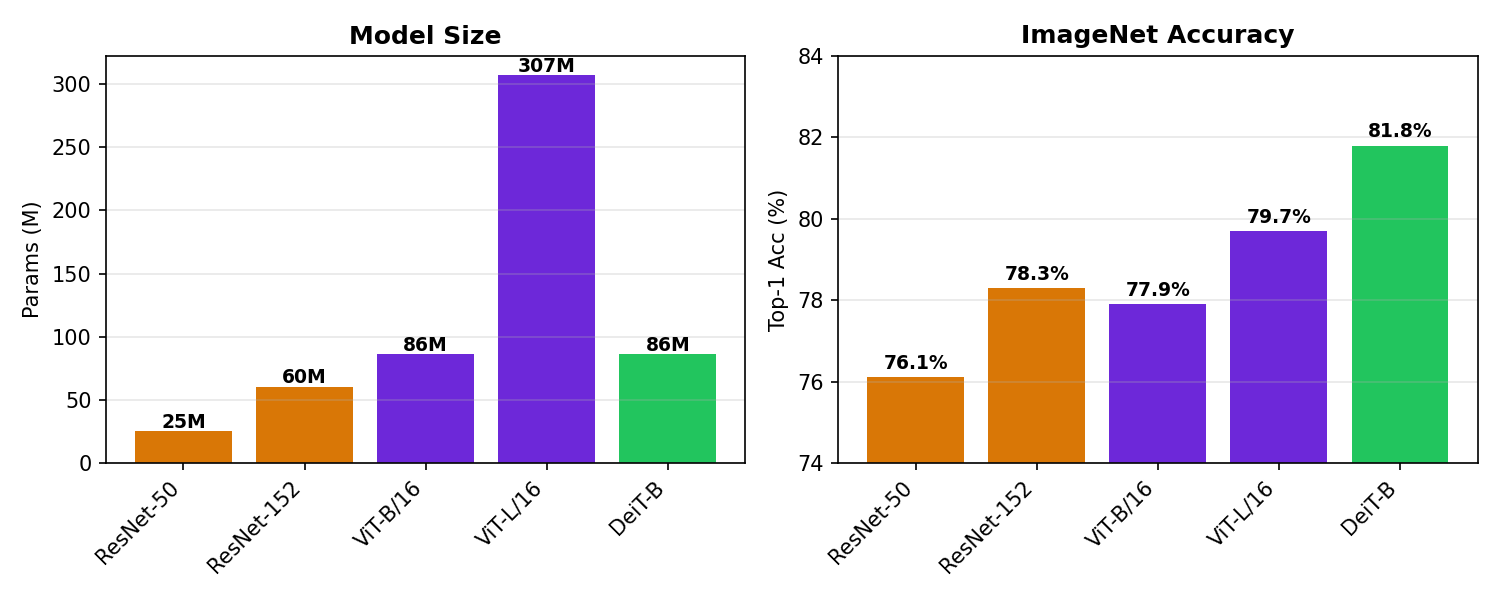
Standard ViT requires large-scale pretraining (ImageNet-21K). DeiT (Data-efficient Image Transformers) achieves competitive results on smaller datasets via knowledge distillation.
Knowledge Distillation
Train ViT with a teacher model (e.g., pretrained ResNet). ViT learns to mimic both true labels and teacher predictions, improving sample efficiency.
📊 CNN vs. Vision Transformer
CNN (ResNet50)
Pros: Local inductive bias (filters), parameter-efficient. Cons: Limited receptive field without deep stacking; slow at high resolution.
Vision Transformer
Pros: Global attention, scalable to high resolution, interpretable attention. Cons: Requires large pretraining or distillation; attention is O(n²) complexity.
Hybrid Models (e.g., Swin Transformer)
Combine CNN's local inductive bias with transformer scalability. Attention window slides spatially (like convolution). Best of both worlds for medical imaging.
Task: Train ResNet50 and ViT on retinal images. Compare: (1) AUC on test set, (2) training time, (3) inference time per image, (4) attention visualization vs. activation maps. Which architecture is better for Priya's use case?
Hint: ViT shines on high-resolution images and global patterns. CNNs are faster at inference. For medical diagnosis, interpretability (attention) may matter more than raw speed.
💼 Interview Questions
✓ Quick Quiz
📋 Quick Cheatsheet
| Concept | Code / Formula | Notes |
|---|---|---|
| Patch embedding | patches = (H // P, W // P); embed = Linear(P*P*C, D) |
Split image → flatten → project to D-dim |
| Number of patches | n_patches = (img_size // patch_size) ** 2 |
512×512 with 16×16 patches = 1,024 |
| Sequence length | seq_len = n_patches + 1 # +1 for [CLS] |
1,025 tokens: 1 [CLS] + 1,024 patches |
| Position embedding | pos_embed = nn.Parameter(torch.zeros(1, seq_len, D)) |
Learnable; encodes spatial structure |
| Transformer encoder | TransformerEncoder(encoder_layer, num_layers) |
Multi-head attention + MLP; each layer processes all patches globally |
| [CLS] token output | cls_out = x[:, 0]; logits = head(cls_out) |
Classification uses [CLS] token; other patches provide context via attention |
| Knowledge distillation loss | α * CE(student, labels) + (1-α) * KL(student, teacher) |
Typical α=0.5; helps on small datasets (DeiT) |
| Attention visualization | attn_map = model.get_attention(image); heatmap(attn_map) |
Interpretability: show which patches influenced prediction |
⚠️ Common Mistakes
✦ Key Takeaways
- Vision Transformers (ViT) apply transformer self-attention to image patches. Global receptive field enables better understanding of long-range dependencies—critical in medical imaging.
- ViT architecture: patch embedding → position embedding → [CLS] token → transformer encoder → classification head. Each patch attends to all others.
- ViT outperforms CNNs on high-resolution images and interpretability. CNNs remain faster at inference and more parameter-efficient on small datasets.
- Knowledge distillation (DeiT) makes ViT practical on small datasets like Priya's 12K retinal images, combining student ViT with teacher ResNet.
- Attention visualization is clinically valuable: show which retinal patches (hemorrhages, microaneurysms) drove the DR diagnosis—building clinician trust.
- Priya's ViT achieves 0.945 AUC on diabetic retinopathy detection, outperforming her CNN baseline (0.89 AUC) and enabling interpretable predictions.
You've mastered Vision Transformers.
Now build interpretable medical AI.
Join the Best AI Program: The AI-Era Agentic Engineer — 5 months, fully online, with placement assistance. Week 1 is free.
Explore The AI-Era Agentic Engineer →