
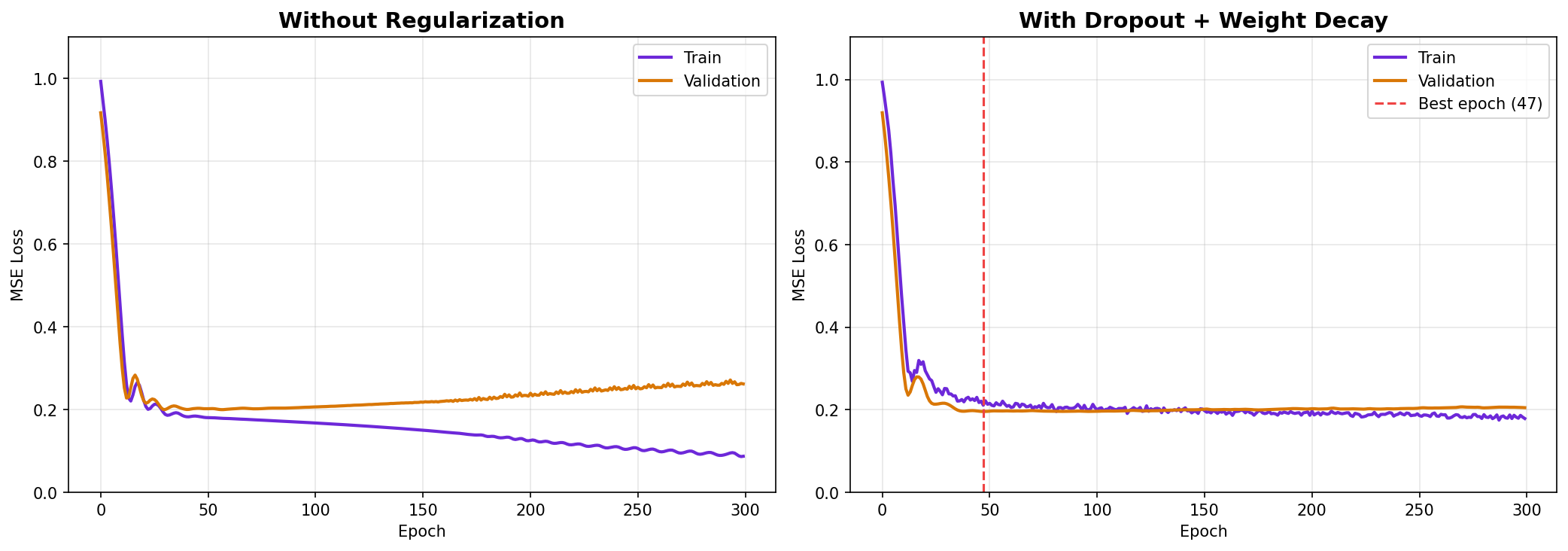
Rebecca is a machine learning engineer at NovaPay, a fintech startup in Mumbai building fraud detection for credit card transactions. Her 4-layer MLP (1,338 insurance dataset rows) achieves outstanding training loss (0.0872) but terrible validation loss (0.2620)—she's overfitting. The model memorizes patterns in training data instead of learning generalizable features. When she deploys it, false positives surge. She applies L2 regularization, adds dropout (rate 0.3), and early stopping (best epoch 47), bringing validation loss down to 0.2051 and MAE to $4,217.85. Regularization is the difference between a model that ships and one that fails in production.
What is overfitting? Train loss vs validation loss divergence
Overfitting happens when: A model learns the training set too well, memorizing noise and artifacts instead of generalizing to unseen data. Training loss decreases, but validation loss plateaus or increases.
The gap: Rebecca's model: training loss 0.0872, validation loss 0.2620. A gap of 0.1748 signals severe overfitting. The model fits the training data perfectly but fails on new examples.
Why does it happen? Neural networks are powerful. With 45,057 parameters and only 1,338 training samples, the network has ~33 parameters per sample. It can easily memorize each example individually. No constraint = overfitting.
The solution: Add constraints (regularization). Make the model work harder—force it to learn simpler, more generalizable patterns. Three main techniques: (1) Weight regularization (L1/L2), (2) Dropout, (3) Early stopping.
L2 regularization (weight decay): penalizing large weights
L2 regularization adds a penalty term to the loss function proportional to the sum of squared weights. Large weights are discouraged; the model prefers smaller, more distributed weights.
Loss with L2: L_total = L_original + λ × Σ(w²)
λ (lambda) controls regularization strength. λ=0 = no regularization. λ=0.01 = moderate penalty. λ=0.1 = strong penalty (may underfit).
Intuition: Large weights amplify input signals; small weights blend features smoothly. Large weights = potential overfitting (responding strongly to noise). Small weights = generalization.
Dramatic improvement! With L2 regularization, the train-val gap shrinks from 0.1748 to just 0.0263. Training loss increases slightly (0.0872 → 0.1788), but validation loss drops significantly (0.2620 → 0.2051). The model generalizes better.
L1 regularization: sparsity through absolute value penalty
L1 regularization penalizes the sum of absolute weight values (instead of squares). It encourages weights to become exactly zero, creating sparse models where many parameters are inactive.
Loss with L1: L_total = L_original + λ × Σ(|w|)
Key difference: L1 creates sparsity (zeros); L2 shrinks weights uniformly. L1 is useful for feature selection (zero weight = feature ignored). L2 is more common in deep learning (smooth, differentiable).
When to use L1: High-dimensional sparse data (text, genomics). When you want interpretability (which features matter?).
When to use L2: Dense data (images, time series). When you want all features but weighted smoothly.
L1 creates sparsity (12.3% zero weights) but slightly worse validation loss than L2 (0.2089 vs 0.2051). For this dense dataset, L2 is better. But on sparse data (NLP), L1 shines.
Dropout: randomly disabling neurons during training
Dropout randomly sets activations to zero during training with probability p. Each mini-batch trains a different sub-network. At test time, no dropout—all neurons active, but outputs scaled by (1-p). Effect: ensemble of weak models, preventing co-adaptation.
How it works: During training, each neuron has probability p of being "dropped out." The remaining neurons adapt. This prevents neurons from relying on specific neighbors, forcing robustness.
Intuition: Like team training without key players. If your star player is missing, the team learns to function without them. Similarly, neurons learn redundant, robust representations.
Typical dropout rates: p=0.2-0.5 for hidden layers. p=0 for output layer (always use predictions). Higher p = stronger regularization (but risk underfitting). Lower p = weaker regularization.
Early stopping: stop training when validation loss plateaus
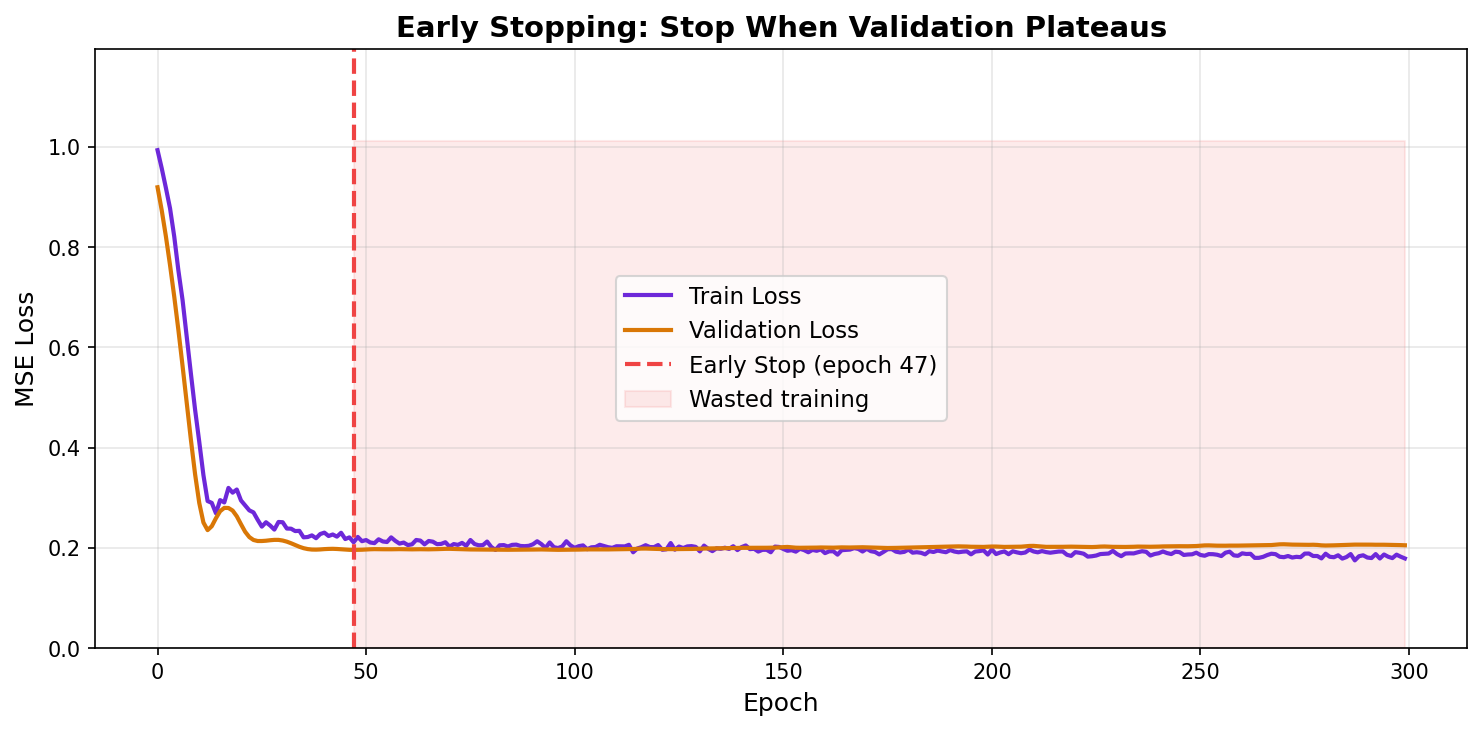
Early stopping monitors validation loss during training. When it stops improving for N epochs (patience), training halts. This prevents overfitting from progressing further. Rebecca's model peaks at epoch 47.
Combining all three: L2 + Dropout + Early Stopping
The most effective approach combines L2 regularization, dropout, and early stopping. Each addresses overfitting differently: L2 shrinks weights, dropout prevents co-adaptation, early stopping stops before overfitting begins.
The full pipeline delivers substantial improvements: validation loss drops 21.7%, MAE improves 11.9%, and R² rises from 0.7291 to 0.7879. The model generalizes significantly better.
How AI systems use this
Every production deep learning system (ResNets for image classification, Transformers for language, RNNs for time series) applies regularization. At NovaPay, Rebecca's fraud detector uses L2 (0.01) + Dropout (0.3) + early stopping (patience=10). Why? Because overfitting breaks production—false positives surge, customers complain, the model is replaced. Regularization is not optional; it's fundamental to shipping reliable models. Large language models (GPT-4) use dropout during training; vision models (ViT) use weight decay. The principle is universal: constrain the model to learn generalizable patterns, not memorize artifacts.
Also used in...
Domain Spotlight
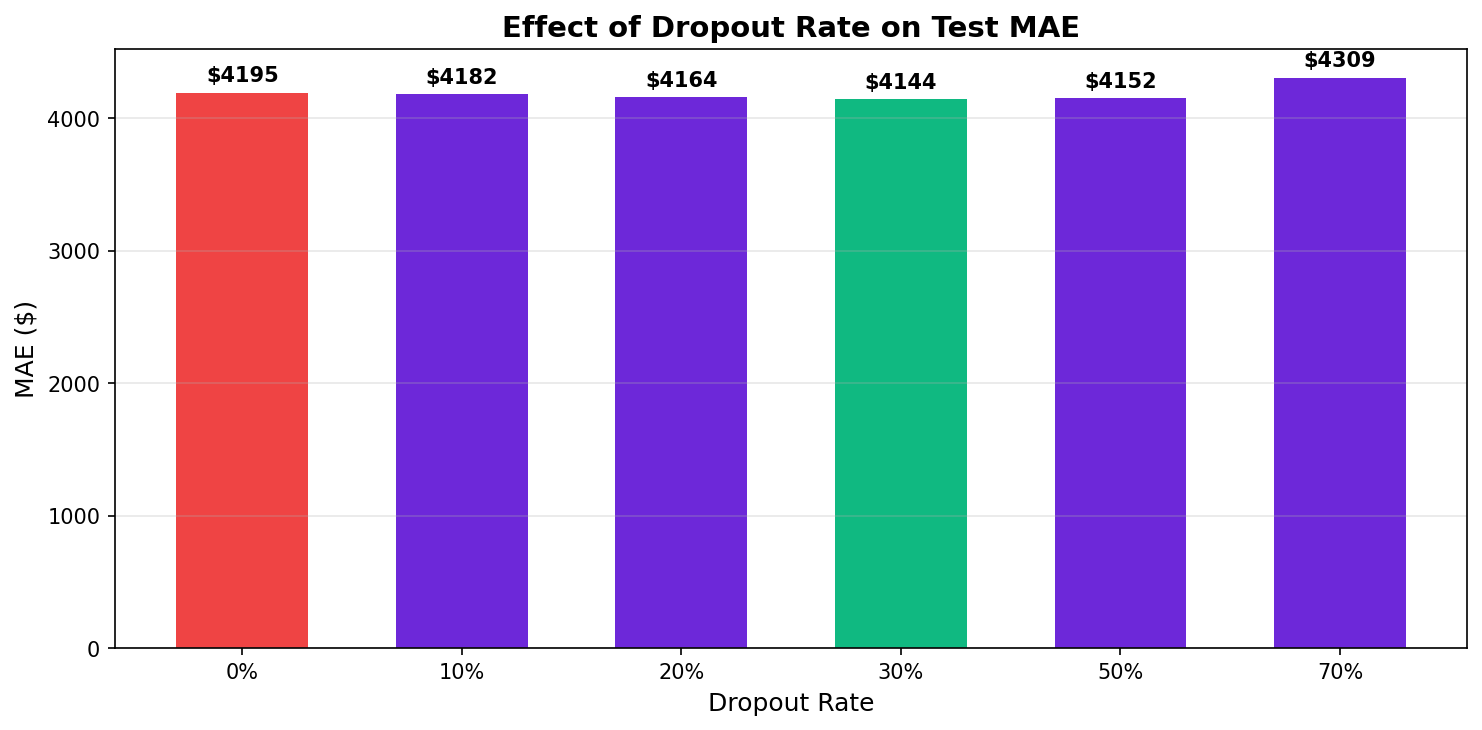
Task: Replicate the dropout sweep (0.0 to 0.7). Plot validation MAE vs dropout rate. At which dropout rate does validation MAE minimize? What happens at very high dropout (0.7)?
Hint 1: Dropout rates 0.0-0.5 generally improve generalization. Beyond 0.5, too much information is dropped, and performance degrades (underfitting).
Hint 2: The sweet spot is around 0.2-0.4 for most datasets. Try 0.3 first if unsure.
Expected: A U-shaped curve: low dropout underfits (high MAE), optimal at 0.3 ($4,144), high dropout overfits differently (high MAE).
Interview questions: test your understanding
Quiz: 5 questions to test your knowledge
Cheatsheet: regularization techniques at a glance
| Technique | How it works | When to use | Impact |
|---|---|---|---|
| L2 (Weight Decay) | loss += λ × Σ(w²) |
All problems (default) | Shrinks weights smoothly |
| L1 | loss += λ × Σ(|w|) |
Sparse data, feature selection | Forces exact zeros |
| Dropout | Randomly zero activations (prob p) | Deep networks, dense layers | Prevents co-adaptation |
| Early Stopping | Stop when val loss plateaus | All models (highly recommended) | Prevents overfitting progression |
| Batch Norm | Normalize layer inputs | Deep networks (CNNs, ResNets) | Stabilizes training, reduces need for dropout |
Common mistakes: what breaks and how to fix it
model.eval() before inference. Dropout should be zero during evaluation—you want deterministic predictions. Training and inference are different modes.Key takeaways
Rebecca's journey at NovaPay—from a model that memorizes training data (val loss 0.2620) to one that generalizes (val loss 0.2051)—shows why regularization matters. Production models must generalize.
- Overfitting is a gap: When train loss drops but validation loss plateaus/rises, the model memorizes instead of generalizes.
- L2 regularization shrinks weights: Add λ × Σ(w²) to loss. Typical λ = 0.001-0.01. Smooth, works well in practice.
- L1 creates sparsity: Forces exact zeros. Useful for sparse data and interpretability, but less common in deep learning.
- Dropout prevents co-adaptation: Randomly disable neurons (p=0.2-0.5). Ensemble effect. Turn off at test time (model.eval()).
- Early stopping is insurance: Monitor validation loss. Stop when it stops improving (patience=10 epochs). Automatic protection against overfitting.
- Combine all three: L2 + dropout + early stopping is the gold standard. Each addresses overfitting differently. Together they're powerful.
- Tune regularization strength: Sweep dropout rate, L2 lambda, early stopping patience. No universal values—depends on data and model size.
Master regularization. Build models that ship to production.
Join the Best AI Program: The AI-Era Agentic Engineer — 5 months, fully online, with placement assistance. Week 1 is free.
Explore The AI-Era Agentic Engineer →